When most parents start looking for help for their child, they assume there is one kind of therapy.
That is not true.
There are at least ten well-established approaches, and the right one depends as much on the child’s age and personality as on the issue at hand.
A four-year-old who hits her brother does not need the same therapy as a fifteen-year-old struggling with anxiety. A child who has lived through a hard event needs a different approach than a child with ADHD.
Knowing the menu of options helps you ask better questions and avoid wasting weeks on the wrong fit.
This guide walks you through the ten most common types of child therapy. For each one, you will see what it is, who it works for, and the typical age range. The goal is a clear map, not a sales pitch.
How Child Therapy Differs from Adult Therapy?
Adult therapy mostly happens through conversation. Child therapy rarely does. Kids communicate through play, drawing, building, and movement.
A five-year-old will not sit on a couch and explain her anxiety. She will draw a stormy sky. A nine-year-old will not describe his anger in clean words. He will act it out with action figures.
A skilled child therapist reads those signals and works through them.
A few other key differences:
- Parent involvement is normal: In most child therapy, parents attend at least some sessions. With younger children, parents often do most of the practice at home.
- Sessions are usually shorter: Many child sessions run 30 to 45 minutes, rather than the adult standard of 50.
- Developmental age matters more than chronological age: A nine-year-old who reads at a five-year-old level needs the same approach as a younger child.
- Goals are concrete: Therapists work toward observable changes, such as fewer tantrums, more sleep, or talking to a friend at school.
These differences matter when you start looking at the ten approaches below. What works for a twelve-year-old will often flop for a four-year-old, and vice versa.
10 Types of Child Therapy
Here is the menu, with what each approach does, who it suits, and the right age for it:
1. Cognitive Behavioral Therapy (CBT)

A child drawing a thought bubble with a friendly therapist during a cognitive behavioral therapy session for kids.
The most studied talk therapy in children. It teaches kids that thoughts shape feelings, and feelings shape actions. The therapist helps the child notice unhelpful thoughts and replace them with ones that better fit reality.
- Best for: anxiety, depression, OCD, PTSD, ADHD-related thinking patterns
- Best age: seven and up, with adapted versions for younger kids
- Typical length: six to twenty sessions
- Format: mostly individual, sometimes in groups
CBT relies on the child being able to think about their thinking, which is why it works best for school-age kids and teens.
2. Play Therapy
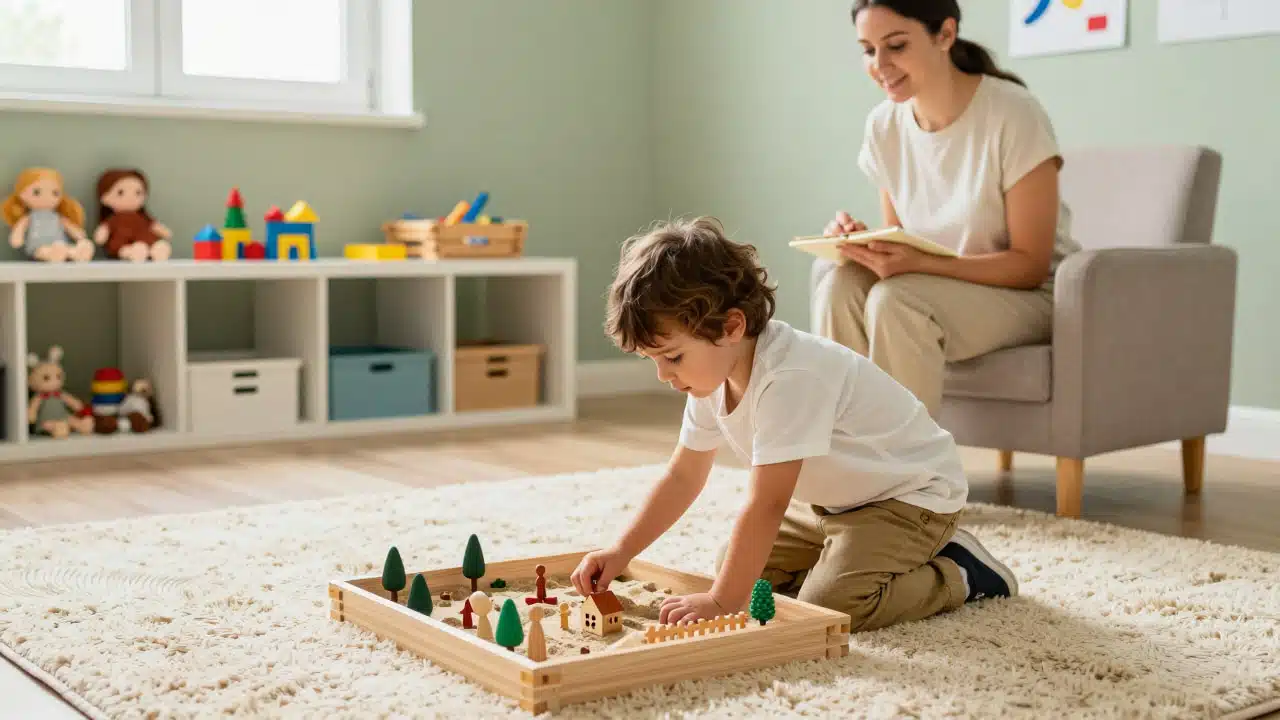
A young child is playing with a sand tray and miniature figures while a therapist watches during a play therapy session.
Play is the natural language of childhood. In play therapy, the therapist sets up a room with carefully chosen toys (dolls, sand trays, puppets, art supplies) and lets the child lead. The therapist watches what the child plays out and gently helps process what comes up.
- Best for: trauma, anxiety, social struggles, processing big life changes like divorce or loss.
- Best age: three to twelve, with the strongest results for ages four to ten
- Format: individual, sometimes with parents joining toward the end
- Two main styles: non-directive (the child leads) and directive (the therapist guides specific play)
Play therapy is often the only option that works for younger kids who cannot yet put their feelings into words.
3. Family Therapy

Family of four sitting together on a sofa across from a therapist during a family therapy session in a sunlit room.
Family therapytreats the family as the unit, not just the child.
The therapist sees the parents, the child, and, sometimes, siblings together. The goal is to shift unhelpful patterns in how the family communicates and handles conflict.
- Best for: behavior problems, parent-child conflict, blended families, divorce adjustment, sibling rivalry
- Best age: all ages
- Format: parents and child together, sometimes with siblings
- Typical length: six to twelve sessions
Family therapy is also one of the most practical types, as it provides families with specific exercises to try at home between sessions.
4. Parent-Child Interaction Therapy (PCIT)

Parent and young child building with wooden blocks while the therapist coaches through an earpiece during a PCIT session.
PCIT is among the most widely researched approaches for young children with disruptive behavior.
The therapist watches the parent play with the child through a one-way mirror or video link and coaches the parent in real time through an earpiece.
- Best for: disruptive behavior, ODD, defiance, frequent tantrums in young children
- Best age: two to seven
- Format: parent-led, therapist coaches
- Typical length: twelve to twenty sessions
The American Academy of Pediatrics recommends PCIT for young children with behavior issues before considering medication.
5. Dialectical Behavior Therapy (DBT)

A teenager and a therapist are working through a DBT skills worksheet on a sofa during a dialectical behavior therapy session.
DBT was created for adults with severe emotional swings. A version for teens, called DBT-A, has grown quickly. It teaches four core skill sets: mindfulness, distress tolerance, emotion regulation, and getting along with others.
- Best for: older teens with self-harm, suicidal thoughts, borderline traits, severe emotional dysregulation
- Best age: thirteen and up
- Format: individual sessions plus weekly skills group
- Typical length: six months to a year, sometimes longer
DBT is rarely used for younger kids. The skills require a level of self-awareness that does not develop until early adolescence.
6. Acceptance and Commitment Therapy (ACT)

Tween is listening to the therapist tell a metaphorical story from a picture book during an acceptance and commitment therapy session.
ACT teaches kids to accept difficult thoughts and feelings rather than fight them, and then to act on what matters most to them. It uses many metaphors and stories, which kids tend to enjoy.
- Best for: chronic anxiety, depression, perfectionism, kids who feel stuck
- Best age: ten and up
- Format: individual or small group
- Typical length: eight to sixteen sessions
ACT is newer than CBT, but the early research on teens is promising.
7. Art Therapy

A child is painting expressive watercolor shapes at a wooden art table while a therapist watches during an art therapy session.
A trained art therapist uses drawing, painting, sculpture, and collage as the main tools, not as a side activity. The art itself becomes a way for the child to express what they cannot put into words.
- Best for: trauma, grief, kids who struggle to talk, anxiety
- Best age: four and up
- Format: individual or group
- Typical length: varies widely
Art therapy works well for kids who freeze in talking-only sessions. It is also a strong fit for kids on the autism spectrum who find direct conversation hard.
8. Group Therapy

A small group of children and a therapist are sitting in a circle on cushions during a child group therapy session.
A small group of kids meets with one or two therapists each week.
The shared experience often lands harder than one-on-one work, especially for tweens and teens. Hearing another kid say “Yeah, I feel that too” is sometimes more healing than anything an adult can offer.
- Best for: social skills, grief, anxiety, divorce groups, addiction in older teens
- Best age: mostly nine and up, with some preschool versions
- Format: small group of four to eight kids
- Typical length: eight to twelve weekly sessions
Group therapy is often cheaper than individual therapy, which makes it easier for families on a tight budget.
9. Eye Movement Desensitization and Reprocessing (EMDR)

A child following the therapist’s finger with their eyes during an EMDR therapy session for trauma in a calm, sunlit room.
EMDR helps the brain reprocess traumatic memories, so they lose their emotional charge. The child recalls a difficult memory while following the therapist’s finger or a moving light with their eyes. The research base is strong.
- Best for: PTSD, trauma, single-event scary experiences like car accidents or medical events
- Best age: seven and up, with adapted versions for younger kids
- Format: individual, sometimes with a parent in the room
- Typical length: eight to twenty sessions
EMDR is one of the few approaches that often works fast for trauma. Some kids feel meaningfully better in three or four sessions.
10. Animal-Assisted Therapy

A child petting a calm golden retriever therapy dog while a therapist watches during animal-assisted therapy.
A therapy dog, horse, or other trained animal joins the session. The animal lowers the child’s anxiety, builds trust, and gives a non-judgmental presence. Equine therapy (with horses) is the most studied form.
- Best for: kids who freeze in traditional therapy, autism, trauma, and severe anxiety
- Best age: four and up
- Format: varies by setting
Animal-assisted therapy is rarely a stand-alone treatment. It usually runs alongside another approach.
Therapy Type by Age
This is the chart most parents wish they had at their first appointment.
| Age Group | Best-Fit Therapy Types |
|---|---|
| 2 to 4 | PCIT, play therapy, parent training |
| 5 to 8 | Play therapy, art therapy, early CBT, family therapy |
| 9 to 12 | CBT, group therapy, family therapy, art therapy, EMDR |
| 13+ | CBT, DBT, ACT, group therapy, family therapy |
Note: Many therapists blend approaches. A nine-year-old with anxiety might do mostly CBT, with some play therapy mixed in for the tougher topics. That blending is normal and often the right move.
Therapy Type by Common Concern
The other question parents always ask: which therapy fits which problem? Here is the practical view:
| Concern | Most-Recommended Therapies |
|---|---|
| Anxiety | CBT, ACT, group therapy |
| Depression | CBT, DBT (teens), behavioral activation |
| OCD | CBT with Exposure and Response Prevention |
| Trauma or PTSD | TF-CBT, EMDR, art therapy, play therapy |
| ADHD | Behavior therapy, parent training, CBT |
| Autism-related behaviors | ABA, PCIT, social skills groups |
| Defiant or disruptive behavior | PCIT, family therapy, parent training |
| Self-harm in teens | DBT |
| Grief or loss | Play therapy, art therapy, and group therapy |
| Family conflict | Family therapy, parent coaching |
This table is a starting point, not a prescription. A licensed therapist will refine the choice after meeting your child.
How to Choose the Right Type for Your Child?
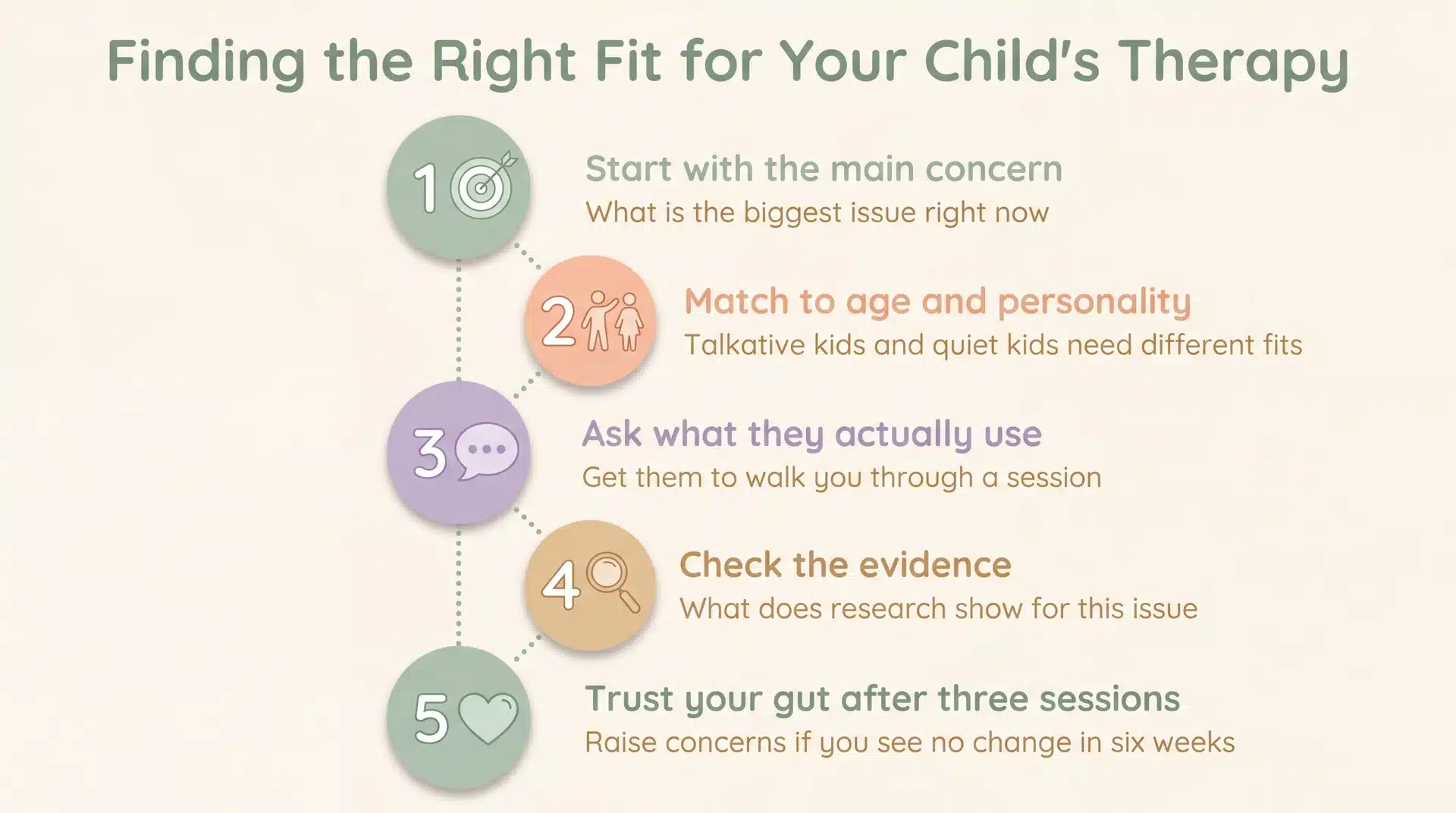
Picking a therapy for your childrencan feel overwhelming. The selection gets simpler when you work through it in this order:
Step 1: Start with the main concern
What is the single biggest issue at home or school right now? Use the concern table above to see which approaches show up most often for that issue.
Step 2: Match to your child’s age and personality
A talkative ten-year-old may do well in CBT. A quieter ten-year-old might do better with art therapy first. Both are valid.
Step 3: Ask the therapist what they actually use
Many therapists describe themselves as “integrative,” which can mean almost anything. Ask them to walk you through what a session looks like, week by week.
Step 4: Check the evidence for that issue
Some approaches have strong research for one problem and weak research for another. Ask the therapist what the evidence shows for your child’s specific situation.
Step 5: Trust your gut after the first three sessions
If your child consistently dreads going, or if you do not see any small change after six weeks, raise it with the therapist. A different approach may work better.
Common Myths
|
Conclusion
Therapy is not one thing. It is a set of tools, and the right tool depends on the child sitting in front of you.
The good news is that the field has come a long way. There are now well-researched approaches for almost every common childhood concern, from anxiety to autism to family conflict.
Bring this guide to your first appointment. Ask the therapist which approach they recommend for your child and why. A confident therapist will explain the reasoning in plain language. If they cannot, that is useful information too.
The goal is not to know everything before walking in. The goal is to ask the right questions when you get there.
Frequently Asked Questions
What Are the Six Common Behavioral Disorders?
ADHD, Oppositional Defiant Disorder, Conduct Disorder, Anxiety Disorders, Obsessive-Compulsive Disorder, and Autism Spectrum Disorder are the six most diagnosed behavioral disorders in children.
How to Calm a Dysregulated Child?
Stay calm yourself, lower your voice, offer a quiet space, use slow breathing, name the feeling, and avoid talking through the issue until the child settles.
What Can Trigger Your Child’s Emotional Breakdown?
Hunger, lack of sleep, sensory overload, sudden change in routine, social conflict, school stress, family tension, and feeling unheard are the most common triggers in children.