
Your students walk in scattered and distracted. Minutes later, they’re laughing together, focused, and ready to learn. What changed? One simple morning meeting game.
Morning meeting games are the secret weapon teachers use to build classroom community fast. These quick activities take just a few minutes but create connections that last all year.
This guide gives you tested games that actually work. You’ll find games for every situation: calming hyper students, energizing tired ones, building kindness, or sneaking in academic practice.
No fancy materials needed. No complex preparation required. Just simple games that get students talking, moving, and connecting with each other.
Ready to transform those chaotic first minutes into your favorite part of the day? Let’s start.
Engaging Morning Meeting Games for Elementary Classrooms
These games work for different purposes and time limits. Choose the right one based on your classroom needs and schedule. Each game includes the time needed, best grade levels, and step-by-step instructions.
1. Silent Ball
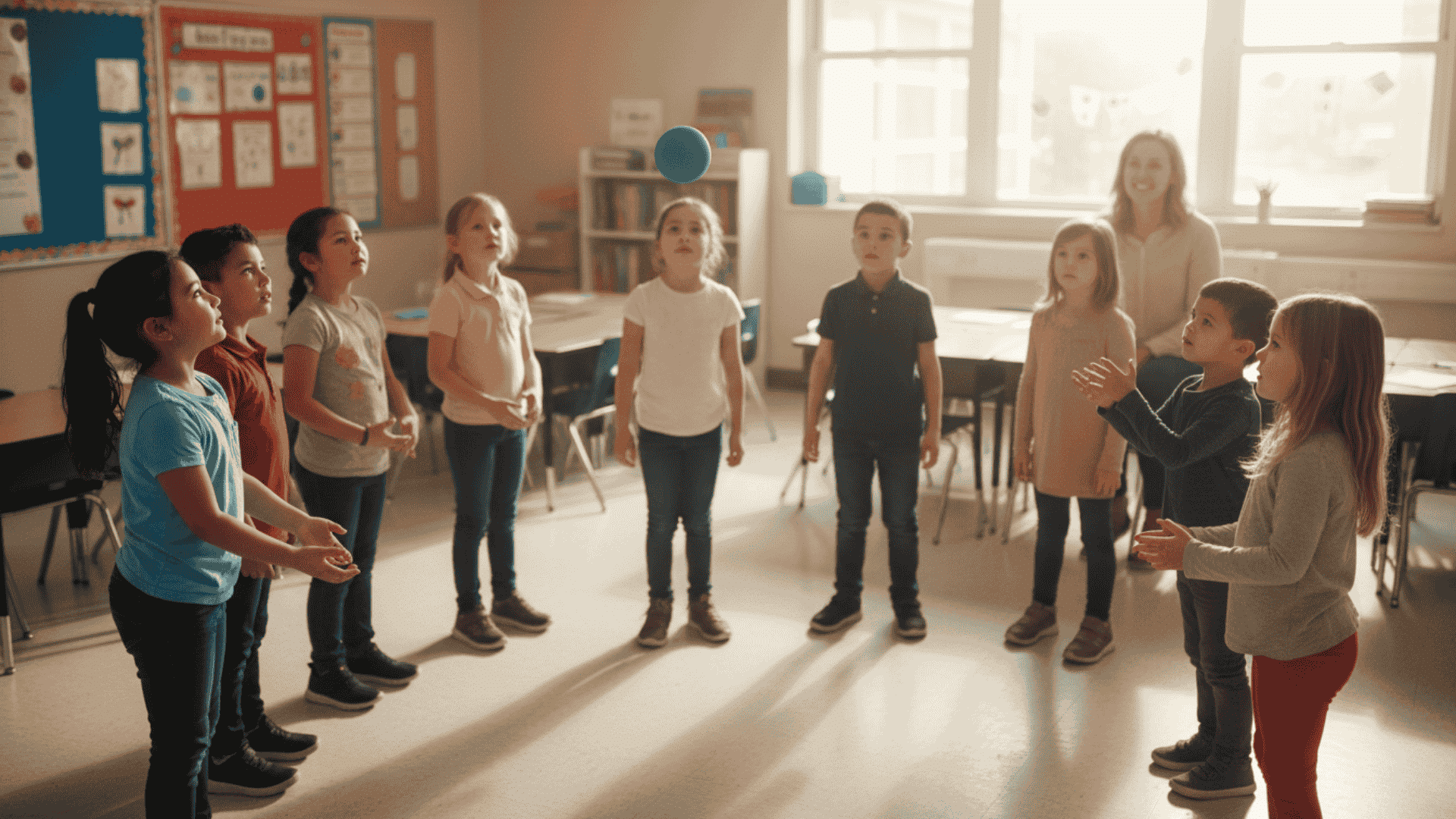
Time: 5-10 minutes | Best for: Grades 2-5 | Skills: Focus, self-control, hand-eye coordination
This calm game helps students practice concentration and gentle movements.
How to play:
- Students stand in their spots around the classroom
- Toss a soft ball to different students
- No talking allowed during the entire game
- If someone drops the ball or talks, they sit down
- The last person standing wins
Why teachers love it: Students must stay alert and watch carefully. The silence creates a peaceful start to the day.
Variation for younger students: Let K-1 students make one sound (like “whoosh”) when they catch the ball.
2. Zip Zap Zop

Time: 3-5 minutes | Best for: Grades K-5 | Skills: Attention, quick thinking, energy
This fast-paced game wakes up brains and gets energy flowing.
How to play:
- Stand in a circle
- First person claps and points to someone while saying “Zip.”
- That person claps, points to someone new, and says “Zap.”
- The next person says “Zop” and continues the pattern
- If someone messes up the order, start over
Why teachers love it: Kids laugh when mistakes happen. The game moves quickly and keeps everyone engaged.
Make it harder: Speed up the pace or add new words like “Zoom” and “Zap.”
3. Pass the Clap

Time: 2-4 minutes | Best for: Grades K-5 | Skills: Timing, teamwork, listening
Students work together to pass a clap around the circle as quickly as possible.
How to play:
- Sit or stand in a circle
- One person starts by clapping once while making eye contact with the person next to them
- That person “receives” the clap and passes it to the next person
- Try to keep the clap moving smoothly around the circle
- How long does it take to complete one full circle
Why teachers love it: This quiet game requires no materials. Students practice working as a team.
Challenge option: Try to beat your class record time. Or pass the clap in both directions at once.
4. Four Corners
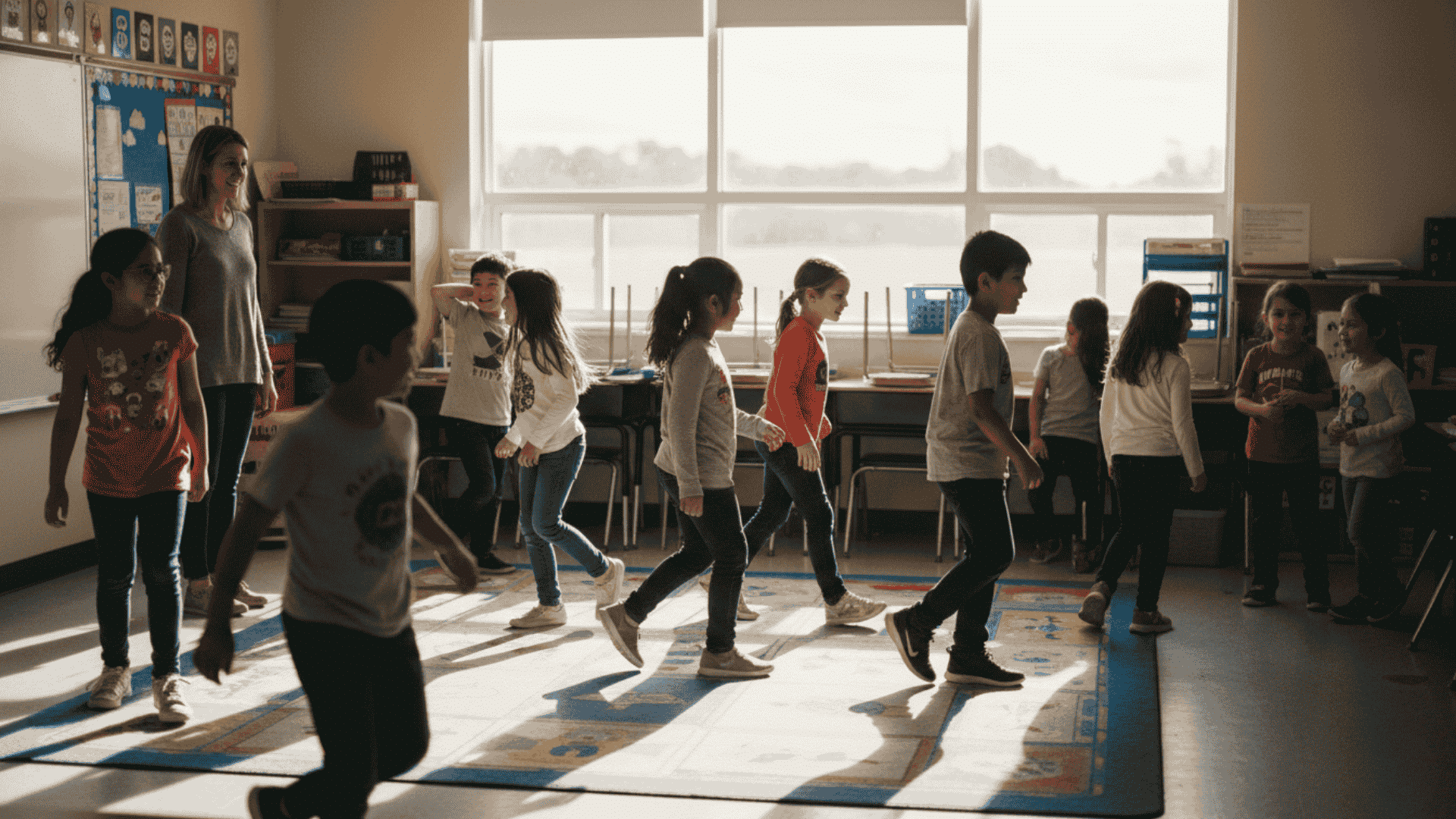
Time: 5-8 minutes | Best for: Grades 1-5 | Skills: Decision-making, movement, opinions
Students move to corners based on their choices or opinions.
How to play:
- Label four corners of your room (A, B, C, D) or with different choices
- Ask a question with four possible answers
- Students walk to the corner that shows their choice
- Call on a few students in each corner to explain why they chose that answer
- Ask a new question and repeat
Sample questions:
- Which season do you like best? (Winter, Spring, Summer, Fall)
- What’s your favorite subject? (Math, Reading, Science, Social Studies)
- Which pet would you choose? (Dog, Cat, Fish, Bird)
Why teachers love it: Kids get up and move. You learn about student interests quickly.
5. Would You Rather Corners

Time: 5-7 minutes | Best for: Grades 1-5 | Skills: Choice-making, reasoning, speaking
This game asks students to pick between two options and defend their choice.
How to play:
- Designate two sides of the room for “Option A” and “Option B.”
- Read a “Would You Rather” question
- Students move to the side that matches their choice
- Pick 2-3 students from each side to explain their reasoning
- Ask a new question
Sample questions:
- Would you rather be able to fly or be invisible?
- Would you rather have pizza or tacos for lunch?
- Would you rather read a book or watch a movie?
Why teachers love it: Students practice explaining their thinking. They see that different opinions are okay.
Academic twist: Use content-related questions. “Would you rather live in a desert or a rainforest?” Then discuss why.
6. Around the World Compliments

Time: 5-10 minutes | Best for: Grades 2-5 | Skills: Kindness, observation, positive language
Students give specific compliments to classmates around the circle.
How to play:
- Sit in a circle
- The first student gives a compliment to the person on their right
- That person says “Thank you,” then gives a compliment to the next person
- Continue around the entire circle
Compliment sentence starters:
- “I noticed you were kind when…”
- “You did a great job at…”
- “I appreciate that you…”
- “You make our class better by…”
Why teachers love it: This builds positive relationships. Students learn to notice good things about others.
Important rule: Compliments must be specific, not just “You’re nice.” Teach students to mention actual actions or qualities.
7. Human Knot

Time: 8-12 minutes | Best for: Grades 3-5 | Skills: Problem-solving, communication, patience
Students work together to untangle themselves without letting go of hands.
How to play:
- Stand in a tight circle (groups of 6-8 work best)
- Everyone reaches across and grabs two different people’s hands
- Don’t grab the hands of people directly next to you
- Work together to untangle into a circle without letting go
- Talk through each step as a team
Why teachers love it: This game requires real teamwork. Students must listen to each other and work together.
Teacher tip: Some knots cannot be untangled. If students struggle for more than 8 minutes, let them restart.
Easier version: Start with just 5 students until they understand how it works.
8. Two Truths and a Wish

Time: 8-12 minutes | Best for: Grades 2-5 | Skills: Listening, critical thinking, self-expression
This twist on the classic game stays positive and future-focused.
How to play:
- Students share three statements about themselves
- Two statements are true facts
- One statement is something they wish or hope for
- Classmates guess which one is the wish
- Student reveals the answer
Example:
- “I have a dog named Max.” (truth)
- “I visited the beach last summer.” (truth)
- “I wish I could learn to play guitar.” (wish)
Why teachers love it: The “wish” twist keeps things positive. Students learn about each other’s dreams and goals.
Time-saver: Do this with just 4-5 students per meeting. Rotate through the class over several weeks.
9. Classmate Bingo

Time: 8-10 minutes | Best for: Grades 2-5 | Skills: Social skills, reading, information gathering
Students mingle to find classmates who match descriptions on their bingo card.
How to play:
- Give each student a bingo card with different traits or facts
- Students walk around asking questions to find matches
- When someone matches a square, they sign their name in it
- First to get five in a row (or fill the whole card) wins
Sample bingo squares:
- Has a pet cat
- Born in another state
- Plays a sport
- Has more than two siblings
- Loves math class
- Can speak another language
Why teachers love it: Quiet students get to talk with everyone. The structure makes socializing easier.
Make it yourself: Create cards based on your class. Include interests, experiences, and characteristics.
10. Mystery Student

Time: 3-5 minutes | Best for: Grades K-5 | Skills: Observation, deduction, attention to detail
Students guess which classmate is missing based on observation skills.
How to play:
- Choose one student to step outside the classroom
- While they’re gone, choose another student to hide in the room
- The first student returns and has three guesses to figure out who’s missing
- Classmates can give hints if needed
- Switch roles and play again
Why teachers love it: This simple game requires zero materials. Students practice noticing who’s in their classroom community.
Variation: For older students, have the missing person change one thing about their appearance instead of hiding.
11. Compliment Chain

Time: 5-8 minutes | Best for: Grades K-5 | Skills: Kindness, memory, listening
Students repeat all previous compliments before adding their own.
How to play:
- Sit in a circle
- The first student gives a compliment to anyone in the circle
- The second student repeats the first compliment, then adds a new one
- Each person repeats ALL previous compliments before adding theirs
- Continue as long as students can remember the chain
Example:
- Student 1: “Maya is a good friend.”
- Student 2: “Maya is a good friend. Jake helps others.”
- Student 3: “Maya is a good friend. Jake helps others. Emma works hard.”
Why teachers love it: Students practice active listening. Everyone receives positive recognition.
Easier version: For K-1, just have each student give one compliment without repeating previous ones.
12. Find Someone Who

Time: 7-10 minutes | Best for: Grades 2-5 | Skills: Communication, reading, social interaction
Students interview classmates to find people who match specific descriptions.
How to play:
- Give each student a list of 8-10 statements
- Students walk around asking questions
- When they find a match, that person signs next to the statement
- The goal is to get as many signatures as possible
- Limit: one signature per person on your sheet
Sample statements:
- Find someone who… has been to a museum
- Find someone who… can count to 10 in another language
- Find someone who… has read more than 5 books this year
- Find someone who… plays an instrument
Why teachers love it: This gets quiet students talking. Kids learn surprising facts about classmates.
13. Common Ground

Time: 6-8 minutes | Best for: Grades 2-5 | Skills: Finding similarities, conversation, and inclusivity
Students work in pairs or small groups to find things they have in common.
How to play:
- Pair up students (try new pairs each time)
- Give them 2-3 minutes to find 5 things they both like or have done
- Pairs share their list with the whole class
- Celebrate the connections students find
Things students might find in common:
- Both have younger siblings
- Both like the same color
- Both play the same sport or game
- Both visited the same place
- Both love the same food
Why teachers love it: Students realize they have more in common than they thought. This builds friendship across different groups.
Extension: Challenge pairs to find three things that most people wouldn’t guess they share.
14. 5-4-3-2-1 Grounding Circle

Time: 4-6 minutes | Best for: Grades K-5 | Skills: Mindfulness, sensory awareness, calming
This calming game helps students feel present and ready to learn.
How to play:
- Students sit or stand comfortably in a circle
- Go around the circle with each prompt
- Students share what they notice using their senses
The prompts:
- Name 5 things you can see
- Name 4 things you can touch
- Name 3 things you can hear
- Name 2 things you can smell
- Name 1 thing you’re grateful for
Why teachers love it: This calms anxious students. It brings everyone’s attention into the present moment.
Quick version: Do just 3-2-1 on busy mornings.
15. Gratitude Toss

Time: 5-7 minutes | Best for: Grades K-5 | Skills: Gratitude, catching, positive thinking
Students toss a ball while sharing what they’re thankful for.
How to play:
- Stand in a circle with a soft ball
- First person says something they’re grateful for
- They toss the ball to someone new
- That person shares their gratitude and tosses it to someone else
- Continue until everyone has had a turn
Example statements:
- “I’m grateful for my family.”
- “I’m thankful for sunny days.”
- “I appreciate my friends.”
- “I’m grateful for books.”
Why teachers love it: Students practice positive thinking. Starting the day with gratitude improves mood.
Variation: Use a specific theme each week (grateful for people, places, things, or experiences).
16. Silent Line-Up

Time: 5-8 minutes | Best for: Grades 2-5 | Skills: Non-verbal communication, problem-solving, cooperation
Students line up in order without speaking.
How to play:
- Give students a challenge to line up by a certain order
- They cannot talk at all during the activity
- They can use hand signals, gestures, or write on paper
- Set a timer for added challenge (try 4-5 minutes)
Line-up challenges:
- Birthday (month and day)
- Height (shortest to tallest)
- First name alphabetically
- Number of siblings (least to most)
- The distance they live from school
Why teachers love it: Students practice creative communication. They must work together without their main tool (talking).
Reflection questions: “How did you communicate without words? What was hard? What worked well?”
17. Positive Affirmation Chain

Time: 4-6 minutes | Best for: Grades K-5 | Skills: Self-confidence, positive self-talk, speaking
Students share positive statements about themselves.
How to play:
- Sit in a circle
- Go around with each student, completing a sentence stem
- Everyone repeats the affirmation after each person shares
- Clap after each affirmation
Sentence stems:
- “I am good at…”
- “I am proud that I…”
- “I am learning to…”
- “I can…”
Example:
- Student: “I am good at helping my friends.”
- Class repeats: “You are good at helping your friends!”
- Everyone claps
Why teachers love it: This builds student confidence. Kids hear their classmates support them.
Important note: Some students struggle with this. Let them pass or whisper to you first if needed.
18. Mindful Minute Challenge

Time: 2-3 minutes | Best for: Grades K-5 | Skills: Focus, mindfulness, body awareness
Students practice staying still and focusing on breathing.
How to play:
- Students sit comfortably at their seats or on the carpet
- Explain that they will close their eyes and breathe quietly
- Set a timer for one minute
- Guide them: “Breathe in slowly. Breathe out slowly.”
- Ring a small bell or chime when time is up
Breathing prompts to use:
- “Feel your breath moving in and out.”
- “Notice your belly moving as you breathe.”
- “If your mind wanders, gently bring it back to your breath.”
- “You are calm and ready to learn.”
Why teachers love it: This quick reset helps students transition from home to school mode.
Build up gradually: Start with 30 seconds for younger students. Add time as they get better at focusing.
19. Math Around the Circle

Time: 5-8 minutes | Best for: Grades 1-5 | Skills: Mental math, listening, number sense
Students solve math problems as they go around the circle.
How to play:
- Sit in a circle
- The teacher calls out a starting number and an operation
- The first student says the starting number
- Next student adds/subtracts/multiplies the chosen number
- Continue around the circle
Examples:
- “Start at 2, add 3 each time” (2, 5, 8, 11, 14…)
- “Start at 100, subtract 5 each time” (100, 95, 90, 85…)
- “Start at 2, double it each time” (2, 4, 8, 16, 32…)
Why teachers love it: This sneaks in math practice. Students help each other if someone gets stuck.
Adaptation: For K-1, just count by ones, twos, or fives around the circle.
20. Vocabulary Hot Seat

Time: 6-10 minutes | Best for: Grades 2-5 | Skills: Vocabulary, describing, critical thinking
One student sits facing away from the board while classmates give clues about a vocabulary word.
How to play:
- Choose one student to sit in the “hot seat” facing away from the board
- Write a vocabulary word on the board behind them
- Classmates take turns giving one-word clues
- The student guesses the word based on clues
- Rotate to a new student and word
Example for the word “ocean”:
- Clues: “Water,” “Salty,” “Waves,” “Fish,” “Blue.”
Why teachers love it: Students practice giving helpful hints. This reviews vocabulary in a fun way.
Subject variations: Use spelling words, science terms, social studies vocabulary, or character names from class books.
21. Spelling Relay
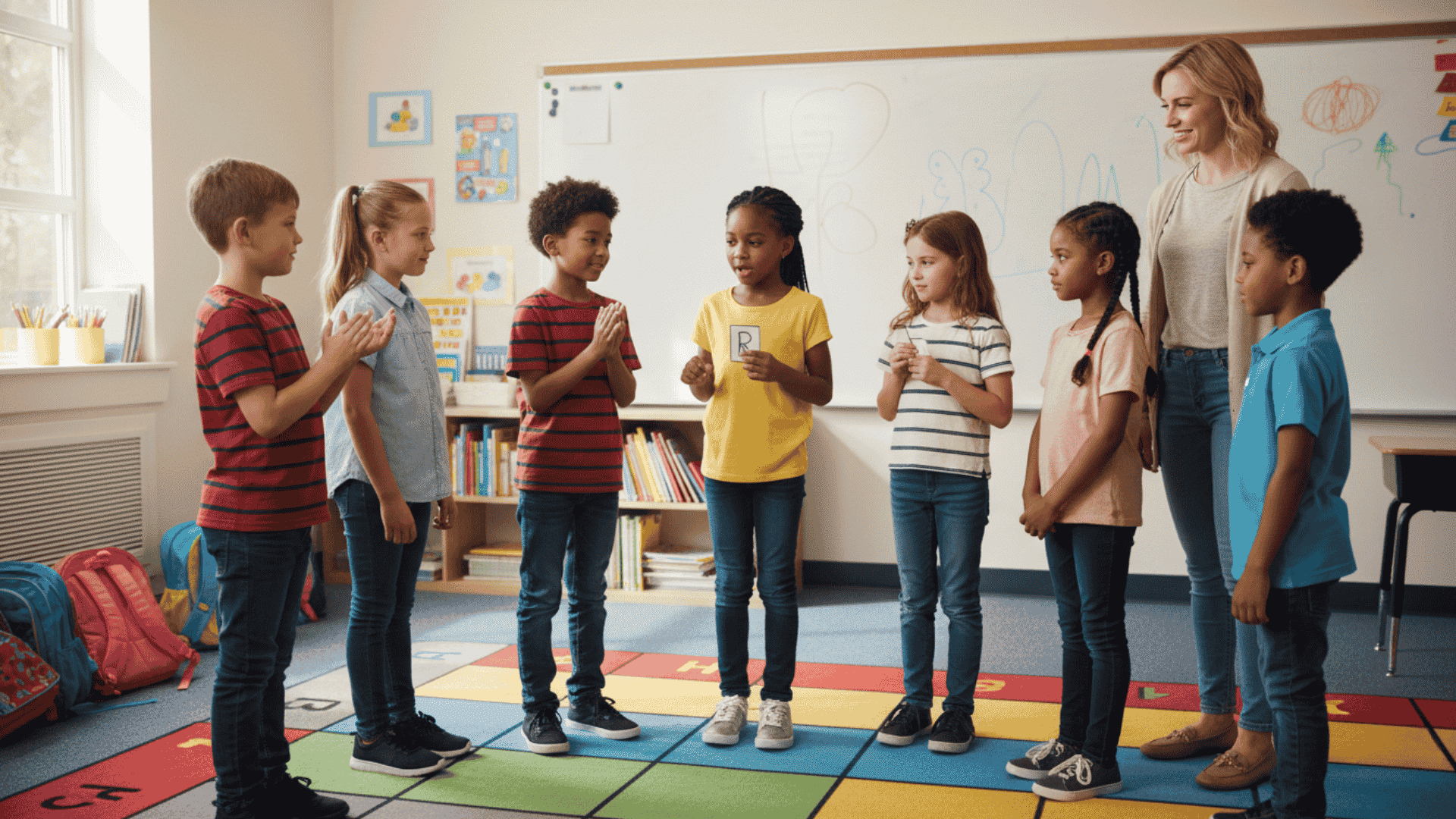
Time: 6-8 minutes | Best for: Grades 1-5 | Skills: Spelling, teamwork, letter recognition
Students work as a team to spell words correctly.
How to play:
- Students stand in a circle
- Call out a spelling word
- First student says the word
- The second student uses the word in a sentence
- Following students spell the word, one letter per person
- After the word is spelled, everyone claps
Example for “happy”:
- Student 1: “Happy”
- Student 2: “I feel happy today.”
- Student 3: “H”
- Student 4: “A”
- Student 5: “P”
- Student 6: “P”
- Student 7: “Y”
- All students clap
Why teachers love it: Every student participates. They help each other remember the correct spelling.
Variation: If someone says the wrong letter, let the group huddle and fix it together.
22. Quick Trivia Toss

Time: 5-7 minutes | Best for: Grades 2-5 | Skills: Knowledge recall, quick thinking, catching
Students answer trivia questions when they catch the ball.
How to play:
- Stand in a circle with a soft ball
- The teacher asks a trivia question and tosses the ball to a student
- That student answers the question
- If correct, they ask a new question and toss to someone else
- If incorrect, the teacher provides the answer, and that student asks the next question
Question categories:
- Math facts
- Science facts
- Geography
- Current read-aloud book
- Class rules or procedures
- Fun facts about classmates
Why teachers love it: This reviews content in a playful way. Students stay alert because they might get called on.
Student-led version: Let students prepare their own trivia questions to ask the class.
23. Word Association Game

Time: 4-6 minutes | Best for: Grades 2-5 | Skills: Vocabulary, quick thinking, connections
Students say the first word that comes to mind based on the previous word.
How to play:
- Sit in a circle
- The teacher says a starting word
- The first student quickly says a word that relates to it
- Next student says a word related to the previous student’s word
- Continue quickly around the circle
Example chain:
- Teacher: “Beach.”
- Student 1: “Sand.”
- Student 2: “Castle.”
- Student 3: “Princess.”
- Student 4: “Crown.”
Why teachers love it: Students think fast and make creative connections. There are no wrong answers.
Challenge version: Go around the circle twice and see how different the word chain becomes.
24. Story Starter Round

Time: 8-10 minutes | Best for: Grades 2-5 | Skills: Creativity, listening, storytelling
Students create a group story by each adding one sentence.
How to play:
- The teacher provides a story starter sentence
- The first student adds the next sentence
- Each student continues the story
- Try to make it funny or add plot twists
- The last student provides an ending
Story starters:
- “Once there was a talking dog who…”
- “When Sarah woke up, she had turned into…”
- “The door slowly opened and inside was…”
- “Nobody believed me when I said I saw…”
Why teachers love it: Students practice listening carefully. They learn to build on others’ ideas.
Extension: Write down the story as students tell it. Type it up and share it later.
25. Fact of the Day Chain

Time: 6-8 minutes | Best for: Grades 2-5 | Skills: Information sharing, listening, memory
Students share interesting facts and try to remember previous facts.
How to play:
- Sit in a circle
- The first student shares one interesting fact about anything
- The second student repeats the first fact, then adds their own
- The third student repeats both previous facts, then adds theirs
- Continue as long as students can remember
Fact categories:
- Animals
- Countries
- Sports
- Science
- Books or movies
- Historical events
Example:
- Student 1: “Sharks have been around for 400 million years.”
- Student 2: “Sharks have been around for 400 million years. The Eiffel Tower is in Paris.”
- Student 3: “Sharks have been around for 400 million years. The Eiffel Tower is in Paris. A group of flamingos is called a flamboyance.”
Why teachers love it: Students share what they’re learning outside school. This builds general knowledge for everyone.
Easier version: Don’t repeat previous facts. Just have each student share one fact.
How to Choose the Right Morning Meeting Games?
Picking the right game makes all the difference. Use this quick guide to match games to your classroom situation each morning.
Game Selection Guide
| What to Consider | How to Decide | Quick Tips |
|---|---|---|
| Energy Level | Read your classroom mood | Hyper students = calming games (Silent Ball, Pass the Clap). Tired students = energizing games (Zip Zap Zop, Four Corners). |
| Time Available | Match game length to the schedule | 2-5 min: Pass the Clap, Mystery Student. 5-8 min: Four Corners, Gratitude Toss. 10+ min: Human Knot, Classmate Bingo. |
| Movement vs. Calm | Rotate throughout the week | Monday = movement. Wednesday = social-emotional. Friday = gratitude/calm. Alternate daily for balance. |
| Skills to Practice | Target specific goals | Teamwork = Human Knot. Kindness = Compliment Chain. Academics = Math Circle, Spelling Relay. |
| Inclusivity | Ensure everyone can participate | Offer sitting/standing options. Let shy students pass. Use visual cues. Never force participation. |
Pro tip: Keep a simple checklist of games you’ve used. Rotate through different types weekly so students stay engaged. Let students vote on Friday’s game to build ownership. |
Choosing the right game is only half the battle. How you run the game determines whether it builds community or creates chaos. These management strategies keep morning meetings running smoothly.
Tips for Managing Morning Meeting Games Successfully
Good games can still fail without proper management. Use these strategies to prevent problems before they start.
1. Set Clear Expectations
- Teach game rules before starting
- Practice once with no winners to learn the process
- Review behavior expectations (listening, respect, turn-taking)
- Model what participation looks like
2. Use Visual Timers
- Display a countdown timer where everyone can see it
- Give 2-minute and 1-minute warnings
- Stop on time every single day
- Students learn to trust the routine when you’re consistent
3. Encourage Equal Participation
- Use popsicle sticks to call on students randomly
- Go around the circle so everyone gets a turn
- Limit each person to one share or answer
- Don’t let the same voices dominate every game
4. Adapt for Shy or Neurodiverse Students
- Let students pass without penalty or pressure
- Offer sentence starters for students who need help sharing
- Allow fidgets during sitting games
- Create buddy systems for students who need support
- Give advance notice about what game is coming
5. Stop Before Energy Becomes Chaotic
- End games while students still want more
- Watch fthe or first signs of silliness or off-task behavior
- Better to stop early than let things fall apart
- Prevents behavior issues and keeps games fun
Key reminders: Model expected behavior yourself. Praise specific positive actions (“I noticed Maya waiting patiently for her turn”). Address problems privately after the game, not during it. If a game flops, try a different one tomorrow without making a big deal about it.
Conclusion
Morning meeting games transform your classroom culture. These simple activities build connections, teach social skills, and create positive daily routines. Your students will look forward to starting each day together.
Start small. Pick three games from this list to try this week. Notice which ones your students love. Add those to your regular rotation.
The time you invest in morning meetings pays off all day long. Students who feel connected behave better, support each other, and take more risks in learning.
Your next step: Choose one game to try tomorrow morning. Set your timer for 5 minutes. Watch your classroom community grow stronger.
What morning meeting game will you try first? Your students are waiting.