Your baby has hives. Your toddler won’t stop scratching bug bites. You reach for the Benadryl in your medicine cabinet, but then you pause. Is this actually safe for babies?
The answer isn’t simple. While Benadryl sits in nearly every household, using it for infants and young children can be dangerous. The FDA warns about serious side effects, including rapid heartbeat and seizures in babies under 2.
This guide explains exactly when Benadryl is safe for children, what symptoms it treats, and which alternatives work better.
You’ll learn proper dosing to prevent overdose, side effects to watch for, and what doctors now recommend instead.
We’ll cover everything from congestion relief to emergency allergic reactions so you can make informed choices about your child’s health.
Jump to This Section if Your Baby Has Already Taken Benadryl
Quick Answer: Is Benadryl Safe for Babies?
No, Benadryl is not safe for babies under 2 years old. The U.S. Food and Drug Administration (FDA) warns that diphenhydramine can cause serious or fatal side effects in infants.
According to Medical News Today, the active ingredient can lead to rapid heart rate and convulsions in young children.
Children under 6 years should not take Benadryl unless a doctor prescribes it. Children’s Hospital Colorado reports that for allergies, it should not be used in babies under 1 year of age because it can make most babies sleepy.
Benadryl does not help with cold symptoms in babies. Nationwide Children’s Hospital explains that improvement in a runny nose is not due to antihistamine properties. The medication simply dries out secretions.
Doctors may prescribe Benadryl for specific allergic reactions, such as hives, under close supervision. Pediatricians sometimes recommend it for mild allergic reactions, but this is different from seasonal allergies.
Never use Benadryl to make your baby sleepy for travel or bedtime.
Benadryl Dosage Chart (Weight-Based)
Benadryl dosing for children is based on weight, not age. According to Children’s Hospital Colorado, you should always use your child’s weight to decide on the right amount.
The standard concentration for Children’s Benadryl liquid is 12.5 mg per 5 mL.
Important: Infants under 6 months should never be given Benadryl unless directed by a healthcare professional. For infants 6 months to 1 year, the usual dosage is 0.5 mg per pound of body weight, up to a maximum of 12.5 mg.
Complete Dosage Chart:
| Weight | Age | Dose | Frequency | Notes |
|---|---|---|---|---|
| 12-17 lbs | 6-11 months | 2.5 mL (12.5 mg) | Every 6 hours | Doctor-directed only |
| 18-23 lbs | 12-23 months | 3.75 mL (18.75 mg) | Every 6 hours | Doctor-directed only |
| 24-35 lbs | 2-3 years | 5 mL (25 mg) | Every 6 hours | Use with caution |
| 36-47 lbs | 4-5 years | 7.5 mL (37.5 mg) | Every 6 hours | Consult pediatrician |
| 48-59 lbs | 6-8 years | 10 mL (50 mg) | Every 6 hours | Generally safe |
| 60-95 lbs | 9-11 years | 12.5 mL (62.5 mg) | Every 6 hours | Monitor for side effects |
| 96+ lbs | 12+ years | Adult dose: 50 mg | Every 6 hours | Maximum 300 mg/day |
Always measure with the syringe or dropper that comes with the medicine. Regular spoons are not accurate. One level teaspoon equals 5 mL, and half a teaspoon equals 2.5 mL.
Do not exceed 4 doses in 24 hours. Never give more than the recommended dose on the label for your child’s specific age or weight. If symptoms persist, contact your pediatrician.
Teens should be cautious about drowsiness. Nationwide Children’s Hospital notes that pilots cannot fly for 30 hours after taking just one dose of Benadryl. This shows how much it can impair reflexes and motor skills.
How to Dose Benadryl Correctly?
Always consult your pediatrician before giving Benadryl to any child. Incorrect dosing can lead to serious harm or death. Use your child’s weight to determine the dose, not their age.
1. Liquid Strengths and Why They Matter
Children’s Benadryl comes in different strengths. The most common is 12.5 mg per 5 mL. Some older formulations had different concentrations.
Always check the label before dosing. Using the wrong strength can result in giving your child too much or too little medication. Never assume all bottles are the same.
2. Measuring Tools That Are Actually Accurate
Syringes and droppers are more accurate than teaspoons. Use the syringe or dropper that comes with the medicine. You can get a medication syringe at drug stores if needed.
Regular kitchen spoons are not reliable and should never be used for medicine. According to Carithers Pediatric Group, measuring spoons should be used instead of regular spoons.
3. What to Do If a Child Spits It Out or Vomits
Do not give another full dose if your child spits out some medicine. If they vomit within 15 minutes of taking it, you can give half the dose again. If they vomit after 15 minutes, wait for the next scheduled dose.
Never try to make up for lost medicine by giving extra. Call your pediatrician if you’re unsure what to do.
Many cold and cough products also contain Benadryl. Always check all medicine labels.
What Benadryl Treats (And What It Does Not)
Benadryl works by blocking histamine in the body. According to the Texas Children’s Hospital, diphenhydramine is a quick-acting antihistamine used to treat short-term symptoms.
What Benadryl Can Treat:
- Allergic reactions with sneezing, itching, and watery eyes
- Hives and rashes from allergic reactions
- Itching from bug bites, poison ivy, or eczema flare-ups
- Runny nose caused by allergies, not colds
- Skin redness and swelling from an allergic contact
What Benadryl Does NOT Treat:
- Nasal congestion or stuffy nose
- Viral colds or upper respiratory infections
- Coughs from chest congestion
- Sinus pressure or sinus infections
- Ear infections or ear pain
The medication dries out mucous membranes but doesn’t speed up recovery from colds. The drying effect can actually create problems throughout the body, not just provide relief.
Side Effects Parents Should Watch For
Benadryl causes side effects in children of all ages. According to ReadySetFood, the medication isn’t very selective and interferes with pathways in the body that don’t need to be affected. This leads to unwanted reactions beyond treating allergies.
Common and Serious Side Effects:
| Side Effect Category | Symptoms to Watch For | What It Means |
|---|---|---|
| Extreme Sleepiness | Child becomes very drowsy, hard to wake up, falls asleep suddenly, exhibits confused behavior, lingering grogginess | Sedation affects the brain; impairs learning and motor skills |
| Hyperactivity | Child becomes agitated, overly excited, cannot sit still, exhibits weird behavior, restless movements | Occurs in 10-15% of children as a paradoxical reaction |
| Dry Symptoms | Dry mouth, extreme thirst, difficulty swallowing, constipation, trouble urinating, thick mucus | Medication is drying out secretions throughout the body |
| Motor Impairment | Slowed reflexes, clumsy movements, difficulty walking, poor coordination | Can last 30-60 hours after just one dose |
| Breathing Issues | Shortness of breath, wheezing, chest tightness, labored breathing | Call 911 immediately – this is anaphylaxis |
| Heart Problems | Rapid heartbeat, irregular pulse, chest pain, pounding sensation | Call 911 immediately – serious reaction |
| Seizures/Convulsions | Uncontrolled shaking, loss of consciousness, stiff body, jerking movements | Call 911 immediately – life-threatening emergency |
If your child shows any emergency symptoms like breathing trouble, rapid heartbeat, or seizures, call 911 right away. Do not wait to see if symptoms improve. These reactions can be fatal in infants and young children.
When Benadryl Should NOT Be Used?
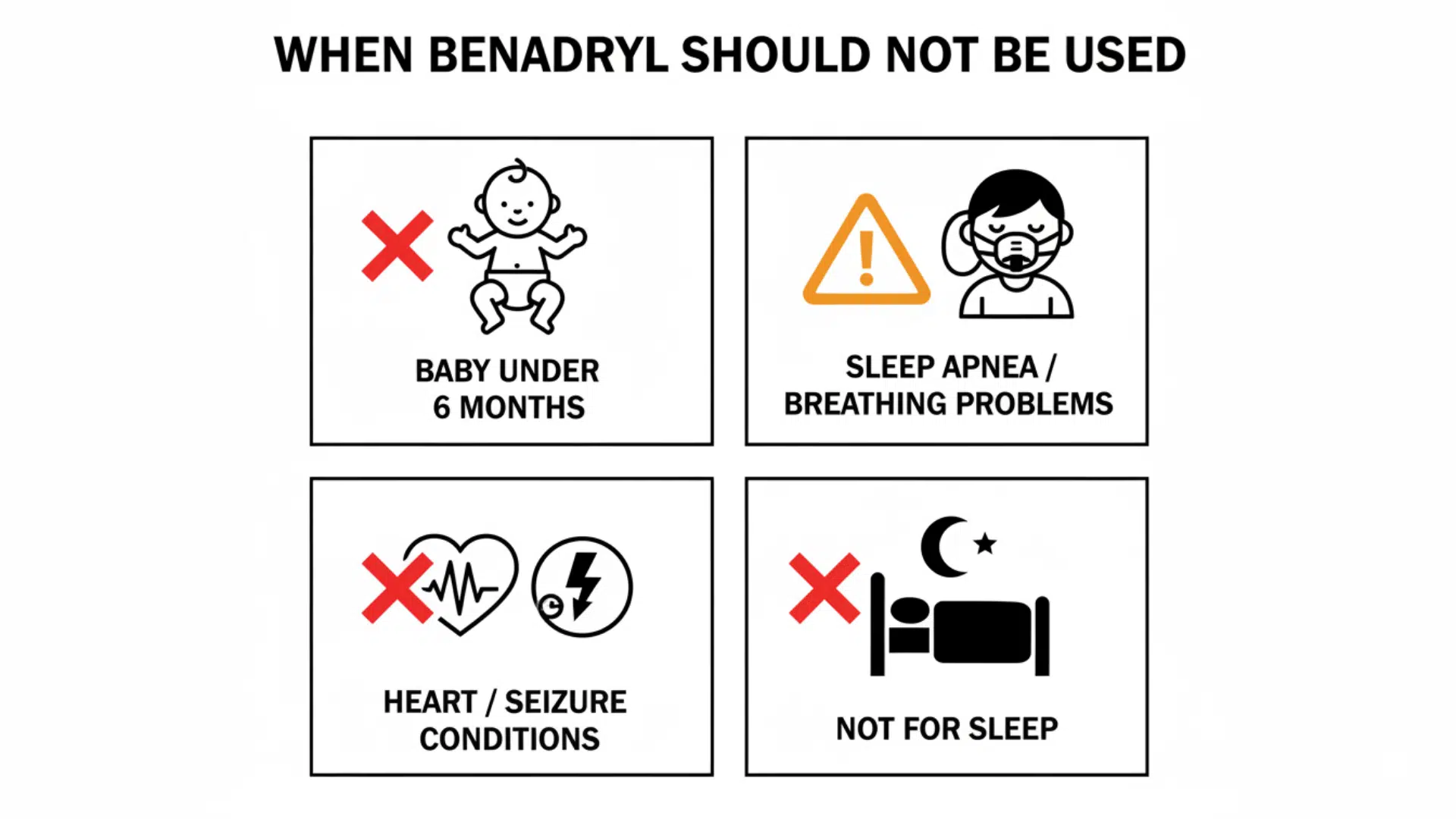
Babies under 6 months old should never receive Benadryl under any circumstances. There are no safe doses for this age group.
Children with breathing problems or sleep apnea should not take Benadryl. The medication can slow down breathing and make it worse.
If your child snores loudly, has pauses in breathing during sleep, or gasps for air at night, tell your doctor before considering antihistamines. The sedating effects can be dangerous for children with existing respiratory issues.
If your child has a history of seizures or heart rhythm problems, Benadryl is not safe. According to MedicineNet, these risks are higher if your child already has these conditions. Talk to your pediatrician about safer allergy medication options instead.
Never use Benadryl as a sleep aid for travel or bedtime. This practice is dangerous and not approved for children. Some parents admit to dosing their children with sleep-inducing medication for flights or car trips. This can lead to respiratory depression or other serious complications.
What to Do If Your Child Already Took Benadryl?
If you already gave your child Benadryl, stay calm and monitor them closely for the next 2 to 4 hours. Write down the exact time and dose you gave. Keep this information ready in case you need to call your doctor or poison control.
Watch for unusual behavior, extreme drowsiness, difficulty breathing, or rapid heartbeat. Do not leave them alone or let them sleep unsupervised for the first hour. Check on sleeping children every 30 minutes.
Call your pediatrician immediately if your child shows signs of an overdose. These include extreme confusion, hallucinations, inability to wake up, seizures, or a very fast heartbeat.
According to SingleCare, children under 2 are at the greatest risk for serious side effects. Poison Control can be reached at 1-800-222-1222.
Do not give more Benadryl for at least 6 hours, even if symptoms return. If your child vomited after taking it, do not give another dose without calling your doctor first. Keep a record of how your child responds and share this with your pediatrician. They can recommend safer alternatives for future allergic reactions.
Safer Alternatives for Babies and Young Children (By Symptom)
There are better options than Benadryl for treating most baby symptoms. Second-generation antihistamines work longer, cause fewer side effects, and have been tested more rigorously in children. Many non-medication approaches can provide relief without any drug risks at all.
1. For Congestion (Non-Medication Relief)
Use saline nasal drops and a cool mist humidifier instead of medication. These clear mucus safely without side effects. Apply saline drops before feedings and bedtime to help your baby breathe easier.
Keep your baby upright or slightly elevated during sleep to help drainage. A humidifier should be placed near the sleep area, but not too close. Clean it daily to prevent mold growth. If you’re breastfeeding, continuing to nurse provides immune support.
2. For Mild Itching and Bug Bites
Apply a cool, damp cloth for 10 to 15 minutes to reduce swelling and soothe itching. This simple method works without any medication risks. Calamine lotion or hydrocortisone cream (0.5% to 1%) can be used on small areas for children over 2 years.
Always check with your pediatrician first for babies under 2. Keep nails trimmed short to prevent scratching and infection. Dress your baby in soft, loose clothing that won’t irritate the affected area.
3. For Hives or Swelling
Ask your pediatrician about second-generation antihistamines instead of Benadryl. According to Norton Children’s, cetirizine (Zyrtec), loratadine (Claritin), and fexofenadine (Allegra) are safer choices. These last 18 to 24 hours, compared to just 4 to 6 hours for Benadryl.
They cause much less drowsiness and don’t impair learning or motor skills. Cetirizine tends to work fastest, taking effect in as little as one hour. Some formulations are approved for babies as young as 6 months old.
4. For Seasonal Allergies
Carolina Asthma & Allergy Center notes that medications like Clarinex and Xyzal are approved for babies over 6 months old. These second-generation antihistamines only need to be given once or twice daily.
They don’t interfere with sleep quality or cognitive performance like older medications. Give them consistently during allergy season for the best results. Start with the lowest effective dose and monitor your child’s response.
Conclusion
Can babies have Benadryl? The answer is clear: not without your doctor’s explicit guidance. Babies under 2 are at serious risk for fatal side effects from diphenhydramine.
Even older children face drowsiness, impaired learning, and other complications that newer medications avoid.
Safer alternatives exist for every symptom Benadryl claims to treat. Second-generation antihistamines like Zyrtec, Claritin, and Allegra work better, last longer, and carry fewer risks. For many symptoms, simple non-medication approaches work just as well.
Before giving any allergy medication to your baby, talk to your pediatrician. They can recommend the safest option based on your child’s age, weight, and symptoms. Keep their number handy and don’t hesitate to call with questions.
Have questions about your baby’s allergy symptoms? Share your concerns in the comments below or schedule an appointment with your pediatrician today.
Frequently Asked Questions
Can Benadryl Affect a Baby’s Sleep Pattern the Next Day?
Yes. Benadryl can cause lingering drowsiness and confusion for up to 30 hours after just one dose. This affects learning abilities and motor skills the following day.
Can Benadryl Cause Nightmares or Night Waking in Toddlers?
Yes. About 10 to 15% of children experience hyperactivity instead of drowsiness. This can lead to restless sleep, night waking, and unusual behavior during the night.
What if Benadryl Stopped Working?
Children can build resistance to Benadryl with repeated use. The body adapts, and the medication becomes less effective. This is another reason to use safer alternatives.
Is Benadryl Safe for Teething Discomfort?
No. Benadryl should never be used for teething pain. It’s only approved for allergic reactions. Use teething rings, cold washcloths, or infant pain relievers approved by your pediatrician instead.