Musical chairs turned into furniture wrestling. Kids cried. One hid under the table. The perfect party plan lasted minutes before chaos took over.
Most parents face this exact scenario when hosting birthday parties at home.
These tested party games work for different ages and spaces without fancy equipment or complicated Pinterest setups. Each game includes setup times, budget details, and fixes for common problems that pop up when kids get excited.
Pick your lineup by mixing an icebreaker to start, high-energy games to burn off excitement, a calm reset when things get too loud, and a memorable finale to end on a high note.
Skip the pressure of perfect parties. Focus on games that keep kids entertained and laughing while you maintain your sanity and actually enjoy the celebration.
Build your party stack below.
Quick Party Formula
You don’t need all 13 games. Smart parents pick 5 games that flow together.
1. The 5-Game Stack
| Position | Type | Purpose | Try This | Time |
|---|---|---|---|---|
| 1st | Welcome Game | Kids join as they arrive | Musical Chairs or Freeze Dance | 10 min |
| 2nd | Move Game | Burn energy early | Balloon Pop Clue Dash or Cup Stack Relay | 15 min |
| 3rd | Laugh Game | Peak party fun | Cookie Face Challenge or Chocolate Game | 15 min |
| 4th | Calm Game | Settle before cake | Pass the Parcel or Sleeping Lions | 10 min |
| 5th | Big Finish | Send-off memory | Treasure Hunt or Piñata Points | 15 min |
Total: 65 minutes of games + 30-45 minutes for food = perfect 2-hour party.
Why this order matters: High-energy games when kids first walk in = instant chaos. Build up to the middle, then wind down.
2. 4 Rules That Save Your Sanity
Demo it first: One quick round teaches more than five minutes of explaining. Kids learn by watching.
Cap at 15 minutes: Attention spans drop fast. End while they’re begging for more.
Team up (3-4 kids): Solo competition = tears. Teams = shared wins and losses.
Skip traditional elimination: The “Fair Play Edition” games below keep everyone playing until the end.
3. Prizes Without the $50 Price Tag
What actually works:
- Sticker sheets kids can trade ($0.50 each)
- Hand-drawn winner badges
- First slice of cake choice
- One extra candle to blow out
- Team points toward the final prize
Party fact: Construction paper crowns excite 6-year-olds more than plastic toys they’ll lose by Wednesday.
Pro move: Birthday child hands out prizes. Other kids accept results better when their friend decides.
Party Games for Kids
Planning party games shouldn’t give you a headache. These tested options work for ages 4-12 without fancy equipment or huge budgets. Each game includes exact setup times, material costs, and fixes for common problems.
Use the 5-game stack above to pick your lineup, then let kids create memories that last longer than the sugar rush.
1. Balloon Pop Clue Dash

Kids pop balloons to find hidden clues leading to treasure. Combines loud, popping fun with mystery-solving.
Quick Stats: 15 min setup | HIGH energy | Very loud | $8 budget | 15×15 feet space
What You Need: 20-30 balloons (2-3 per child), paper clue strips, final prize box, tape
How to Play: Write clues on paper strips. Insert into balloons before inflating. Hide balloons around the space. Kids pop them by sitting or stepping on them. Collect clues to find the treasure location.
What Can Go Wrong + Fix: Balloon fear affects 10% of kids – use bubble wrap instead. Clues too hard? Add picture hints. Too chaotic? Release 5 balloons at a time.
Age Twist: Ages 4-6 use color codes. Ages 7-9 solve riddles. Ages 10-12 assemble puzzle pieces.
Pro Tip: Pre-pop two balloons before the party. Show kids the safe popping method.
2. Musical Chairs (Fair Play Edition)
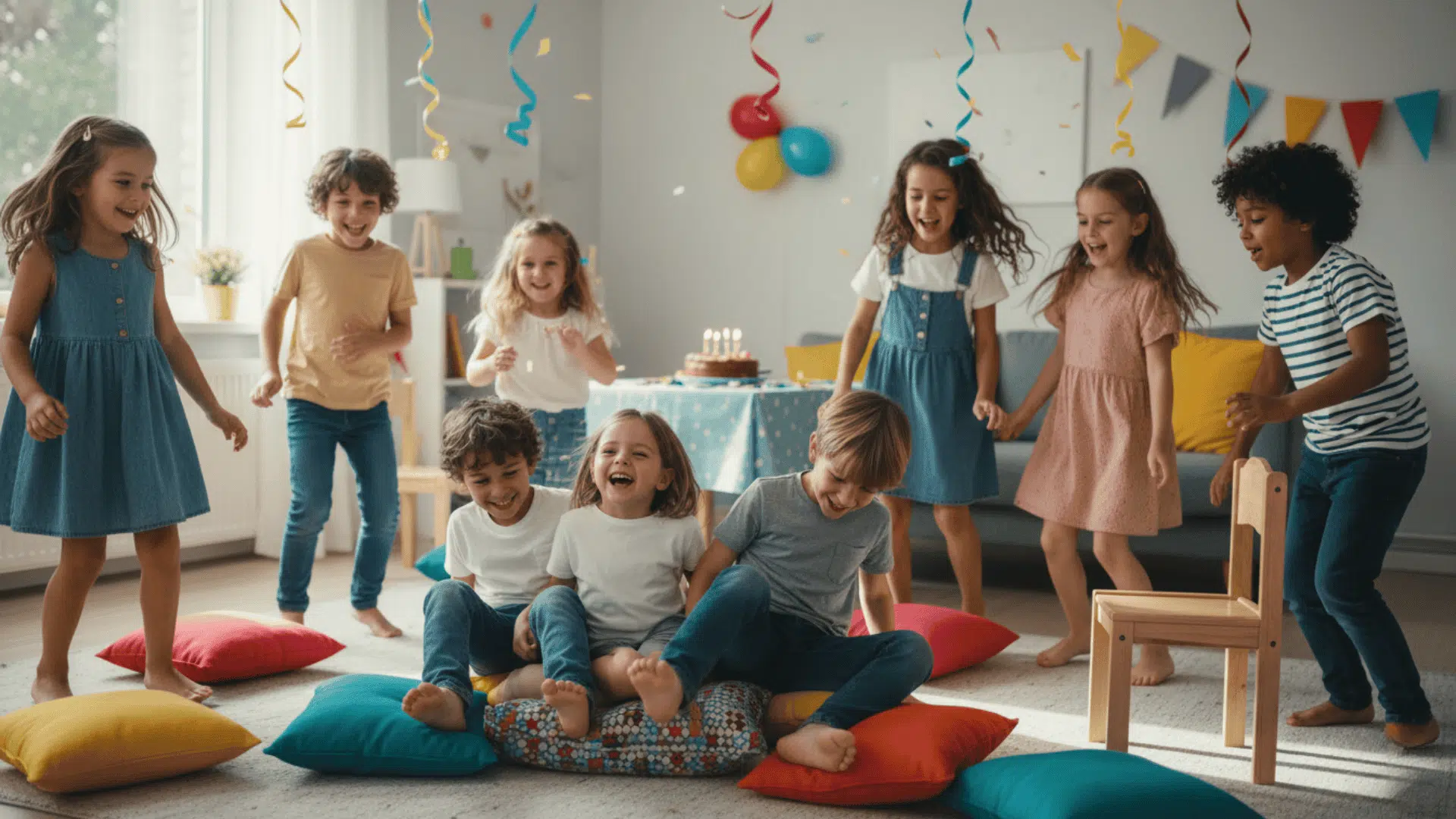
The classic with a twist: nobody gets eliminated and sits out sad. Everyone plays until the final chair.
Quick Stats: 5 min setup | HIGH energy | Loud | $0 budget | 10×10 feet space
What You Need: One chair per child (or cushions), music player, clear floor space
How to Play: Arrange chairs in a circle facing outward. Kids walk around while music plays. When it stops, everyone grabs a seat. Fair Play Twist: Remove chairs but not children. Multiple kids share the remaining chairs by sitting on laps or half-sitting. The final round has everyone touching one chair.
What Can Go Wrong + Fix: Kids fight over seats? Use cushions as “safe zones” – no arguments. Music app crashes? Have a backup playlist downloaded offline.
Age Twist: Ages 4-6 dance slowly. Ages 7-9 use classic speed. Ages 10-12: Try backwards walking or slow-motion mode.
Pro Tip: Adults control music. Rotate who stops it so kids don’t blame one person.
3. Pass the Parcel (Pick Your Prize Version)

Every layer has a prize, but here’s the twist: kids choose from a prize bowl instead of finding one surprise inside.
Quick Stats: 10 min setup | LOW energy | Quiet | $15 budget | Any size space
What You Need: Gift wrapped in 10-12 layers (one per child plus extras), prize bowl with small toys/stickers, music player
How to Play: Wrap a small gift in multiple layers of colorful paper. Kids sit in a circle passing the parcel while music plays. When music stops, that child unwraps one layer AND picks any prize from the prize bowl. Continue until the final layer reveals the main gift.
What Can Go Wrong + Fix: Child misses a turn? Keep a tally chart visible. Paper tears too easily? Use newspaper for inner layers, pretty paper for outer layers only.
Age Twist: Ages 4-6 add stickers between layers. Ages 7-9 include silly forfeits. Ages 10-12: add trivia questions.
Pro Tip: Wrap it the night before. Morning-of wrapping always takes longer than expected.
4. Pin the Tail Remix
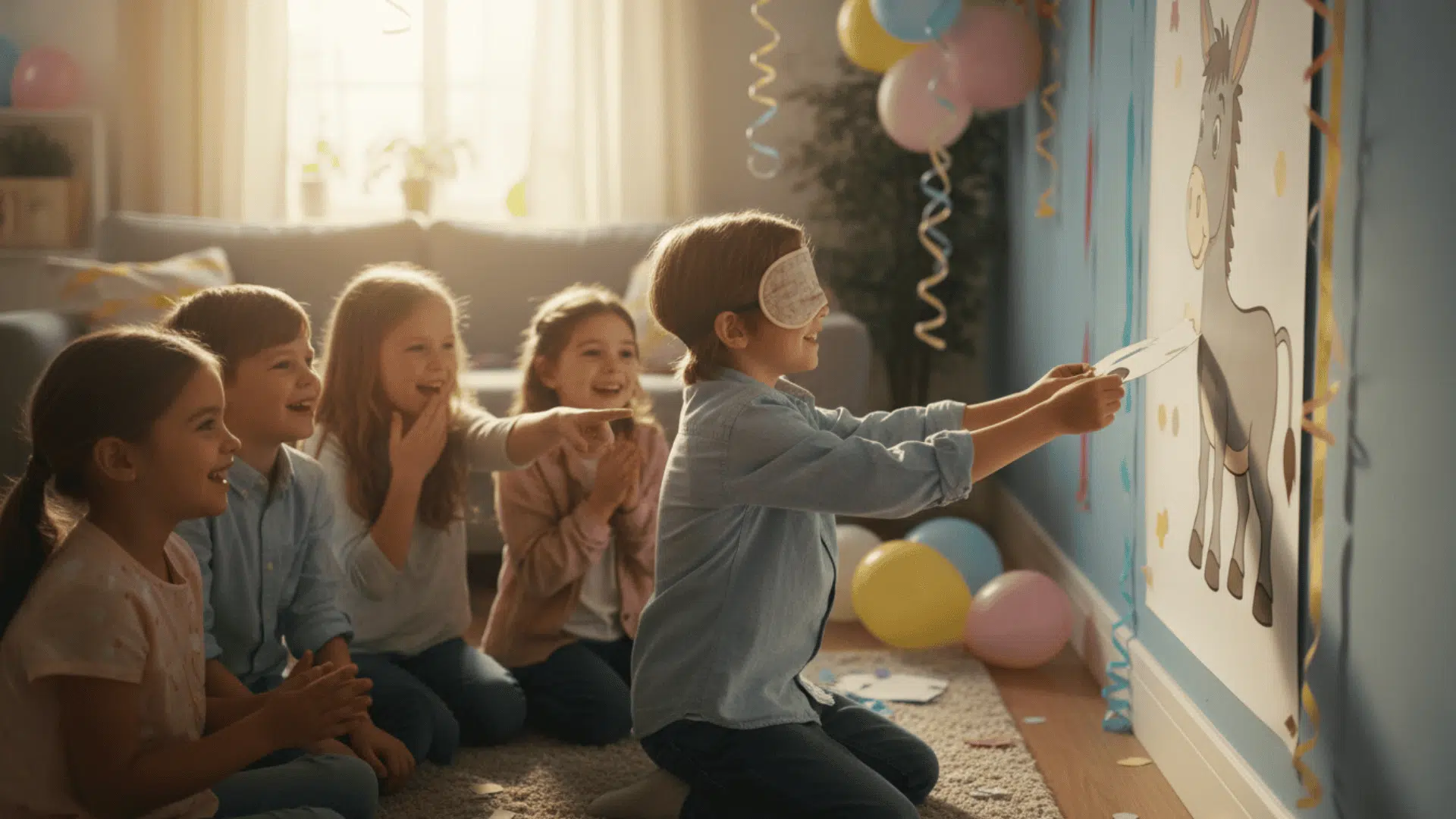
Classic blindfold game with theme customization. Pin anything on anything to match your party vibe.
Quick Stats: 5 min setup | LOW energy | Moderate noise | $5-15 budget | Wall space needed
What You Need: Poster of character/object, paper tails/pieces with tape loops, blindfold or sleep mask, marker
How to Play: Hang the poster at the child’s eye level. Blindfold one child, spin gently (skip for under 6), and hand them the tail piece. They try to pin it in the right spot. Mark each attempt with their name. Closest to the target wins.
What Can Go Wrong + Fix: Kids peek through the blindfold? Use a sleep mask instead. Spinning makes kids dizzy? Skip that part entirely. Wall damage from tape? Use poster putty.
Theme Ideas: Pin the web on Spider-Man, nose on Olaf, crown on the princess, cape on the superhero.
Age Twist: Ages 4-6 skip spinning. Ages 7-9 spin twice. Ages 10-12 spin three times or try it backwards.
Pro Tip: Take photos of each attempt. Kids love seeing their funny placements later.
5. Minute-to-Win-It Cookie Face Challenge

Move a cookie from forehead to mouth using only face muscles. No hands allowed. Pure silly fun.
Quick Stats: 2 min setup | LOW energy | Loud laughter | $5 budget | Minimal space
What You Need: One cookie per child (Oreos work best), napkins, a timer, and wet wipes for cleanup
How to Play: Each child places a cookie on their forehead. Set the timer for one minute. Using only facial movements – scrunching, wiggling, tilting – they move the cookie down to their mouth. First to eat the cookie wins. If it drops, they’re out.
What Can Go Wrong + Fix: Allergy concerns? Check beforehand and use crackers instead. Cookie breaks easily? Use firmer cookies like Biscoff. Kids get frustrated? Allow practice rounds first.
Age Twist: Ages 4-6 use larger, sturdier cookies. Ages 7-9 use standard Oreos. Ages 10-12: Try mini cookies for extra challenge.
Pro Tip: Record this game. The facial expressions are comedy gold, and parents love seeing the footage.
6. Cup Stack Relay (Small Space Friendly)
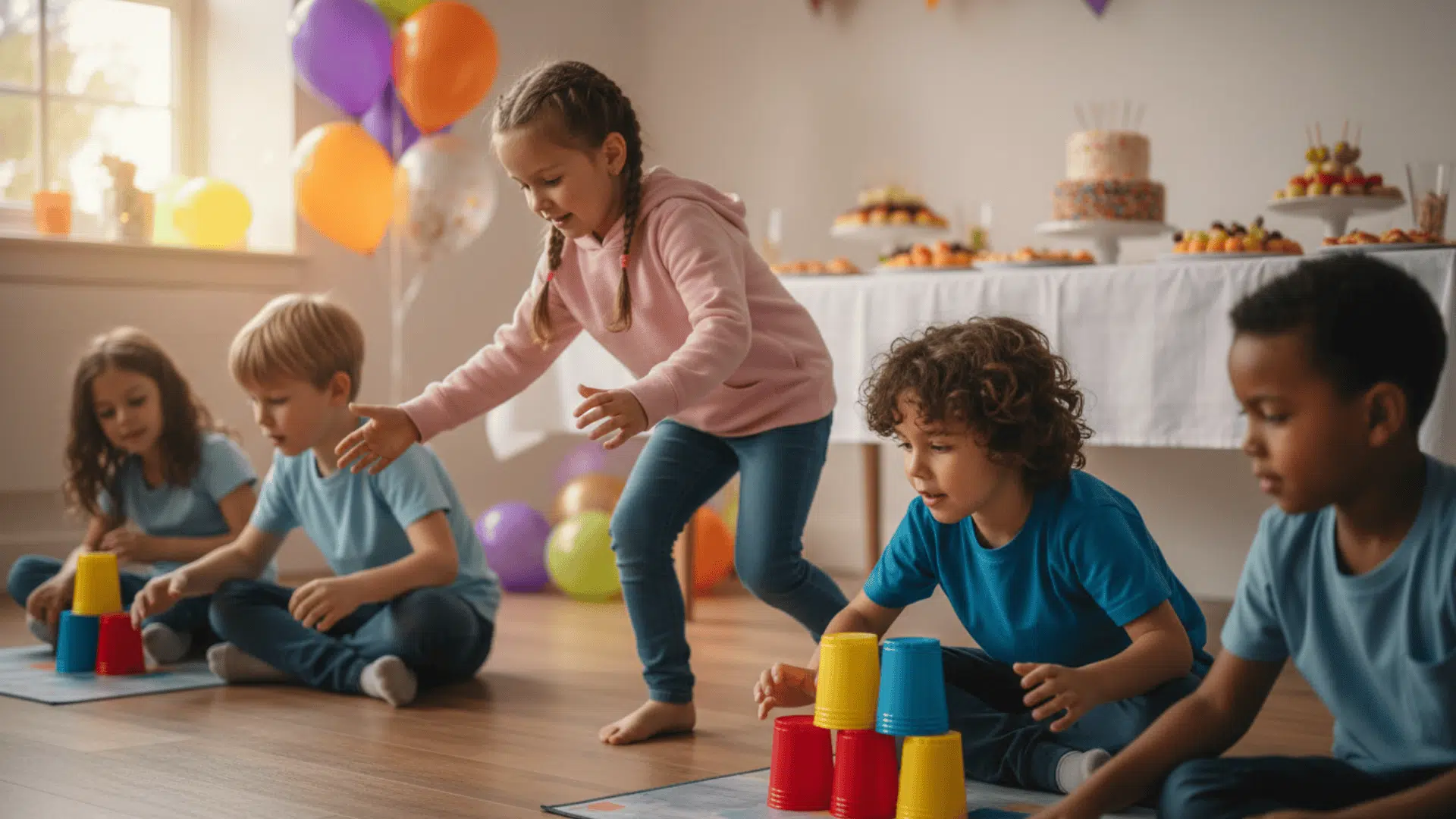
Race to stack and unstack cups in pyramid form. Perfect for apartments or indoor parties with limited space.
Quick Stats: 5 min setup | MEDIUM energy | Moderate noise | $8 budget | 8×8 feet per team
What You Need: 15 plastic cups per team (buy party cup sets), a flat surface like a table or floor, a timer
How to Play: Divide kids into teams of 3-4. Each team gets 15 cups. On “go,” the first player races to stack cups into a pyramid (5-4-3-2-1 formation), then unstacks back into a single tower, then tags the next player. First team with all members completing wins.
What Can Go Wrong + Fix: Cups fall constantly? Use slightly wider cups. Too easy? Add a balloon-keep-up element while stacking. Table too crowded? Use floor space with yoga mat markers.
Age Twist: Ages 4-6 stack only 10 cups. Ages 7-9 use full 15. Ages 10-12: add a blindfold for the final player.
Pro Tip: Dollar store cups work fine. Don’t waste money on expensive sets.
7. What’s the Time, Mr. Wolf? (With Zones)
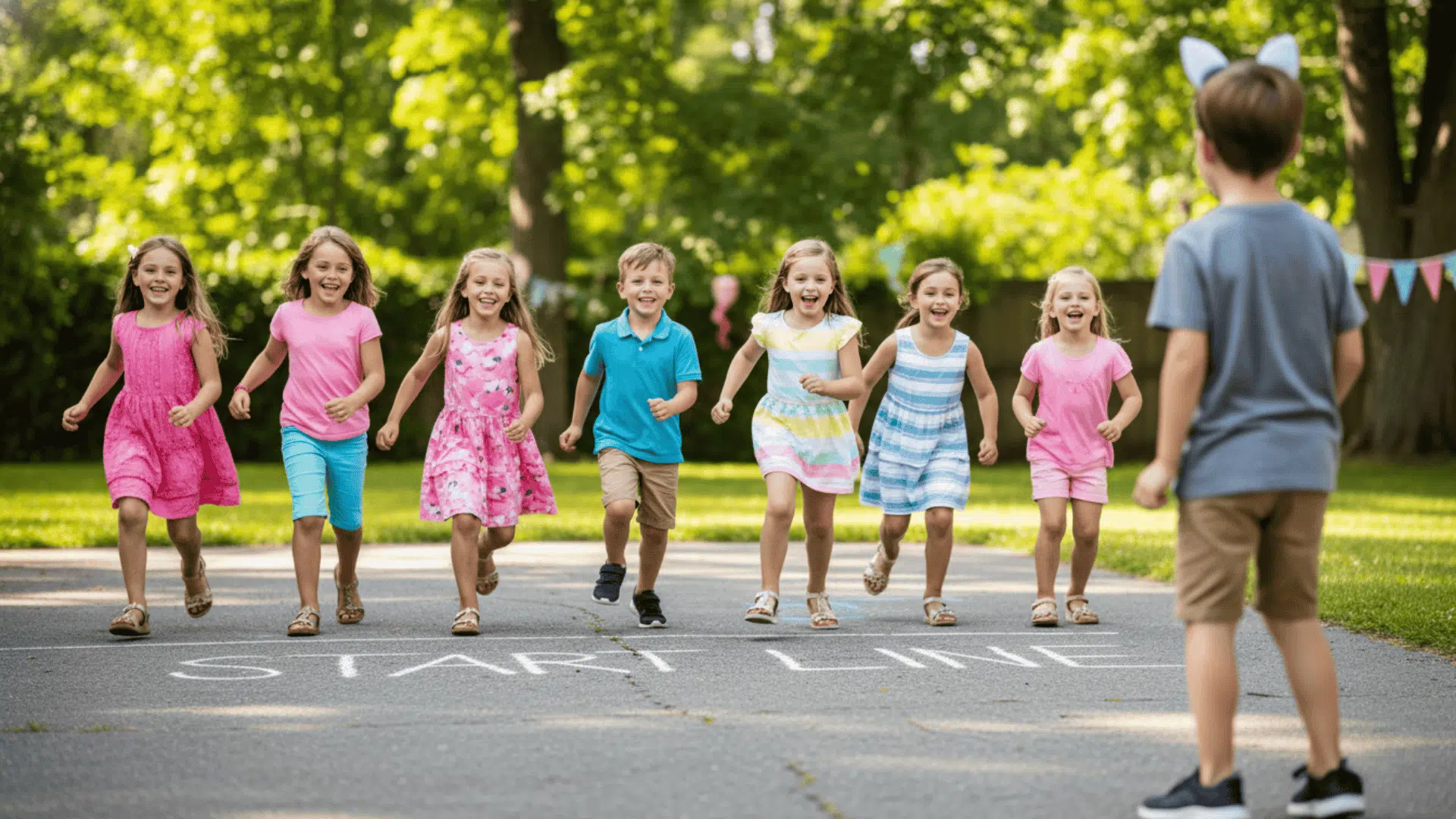
Classic chasing game with zone markers that prevent pile-ups and keep younger kids safe.
Quick Stats: 3 min setup | HIGH energy | Very loud | $0 budget | 20 feet length needed
What You Need: Chalk or tape for zone lines, clear running space, and one volunteer “wolf.”
How to Play: Mark the start line and finish line 20 feet apart. Add safety zones every 5 feet with tape. One child is Mr. Wolf, facing away at the finish line. Others stand at the start line asking, “What’s the time, Mr. Wolf?” Wolf calls out a time (1-12 o’clock). Kids take that many steps forward. When Wolf yells, “Dinner time!” the kids race back to start. Tagged kids become wolves next round.
What Can Go Wrong + Fix: Kids collide while running back? Safety zones let them pause without penalty. Does Wolf always pick the same kid? Rotate the wolf every 2 minutes regardless.
Age Twist: Ages 4-6 walk instead of running. Ages 7-9 use classic running. Ages 10-12: Try hopping or skipping movements.
Pro Tip: Play this second in your party lineup. Burns major energy early when kids are fresh.
8. Treasure Hunt (With Photo Proof Option)
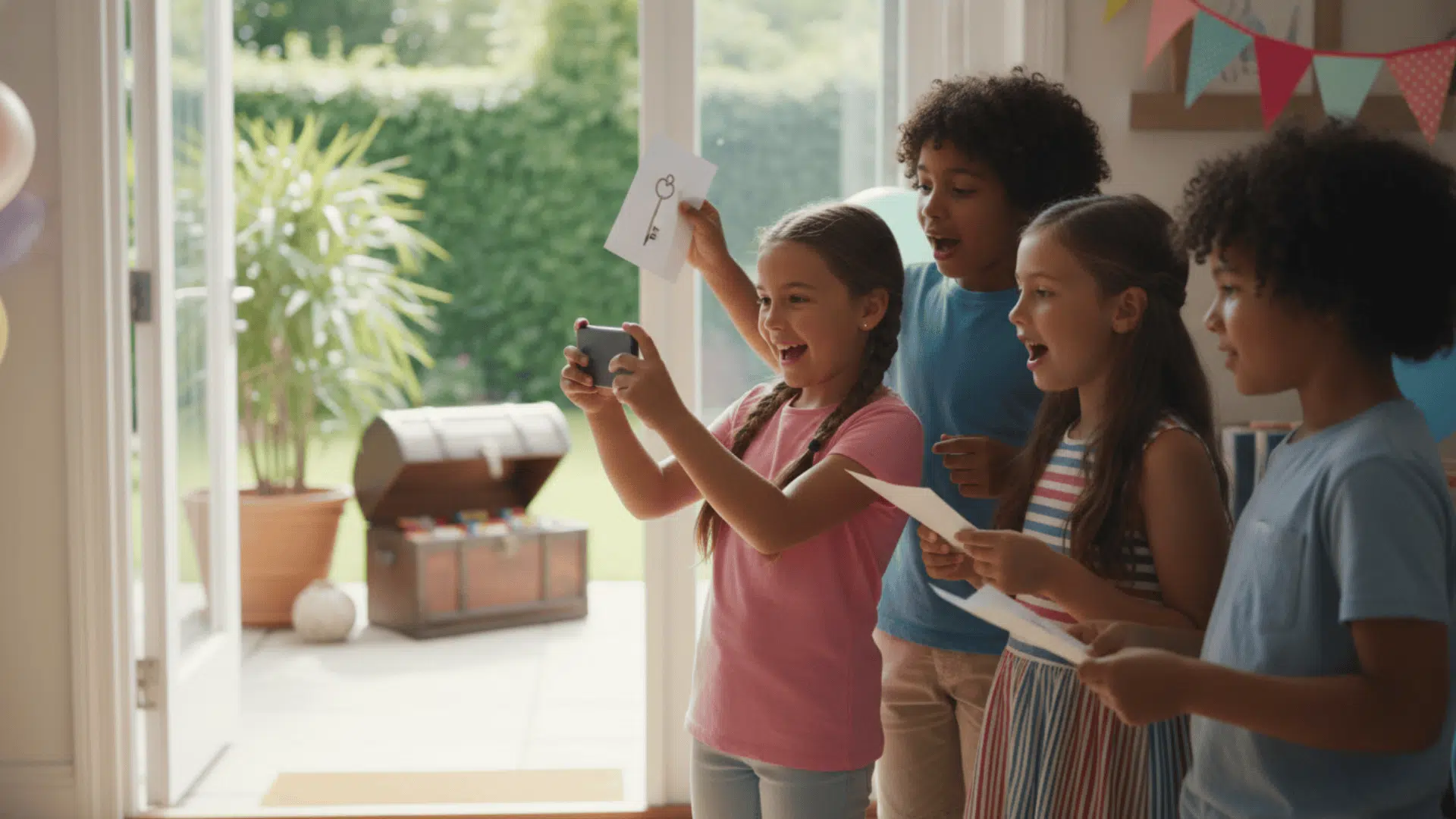
Kids follow clues to find hidden treasure. Photo proof twist stops arguments about who found what first.
Quick Stats: 20 min setup | MEDIUM energy | Moderate noise | $10 budget | Whole house/yard
What You Need: 8-10 clue cards, small treasure box, prizes for inside, smartphone or camera, printed photo cards (optional)
How to Play: Hide clues around your space in sequence. Each clue leads to the next location. Final clue reveals treasure spot. Photo Proof Twist: Kids must snap a photo at each clue location before moving to the next. First team with all photos AND treasure wins.
What Can Go Wrong + Fix: Clues too tricky? Include picture hints alongside words. Teams split up and cheat? Require ALL team members in every photo. Does the weather ruin outdoor hunts? Prep an indoor backup route beforehand.
Age Twist: Ages 4-6 follow picture clues only. Ages 7-9 solve simple riddles. Ages 10-12 decode ciphers or maps.
Pro Tip: Take photos of hiding spots during setup. You’ll forget locations once 10 kids arrive.
9. Freeze Dance Statues (With Challenge Cards)
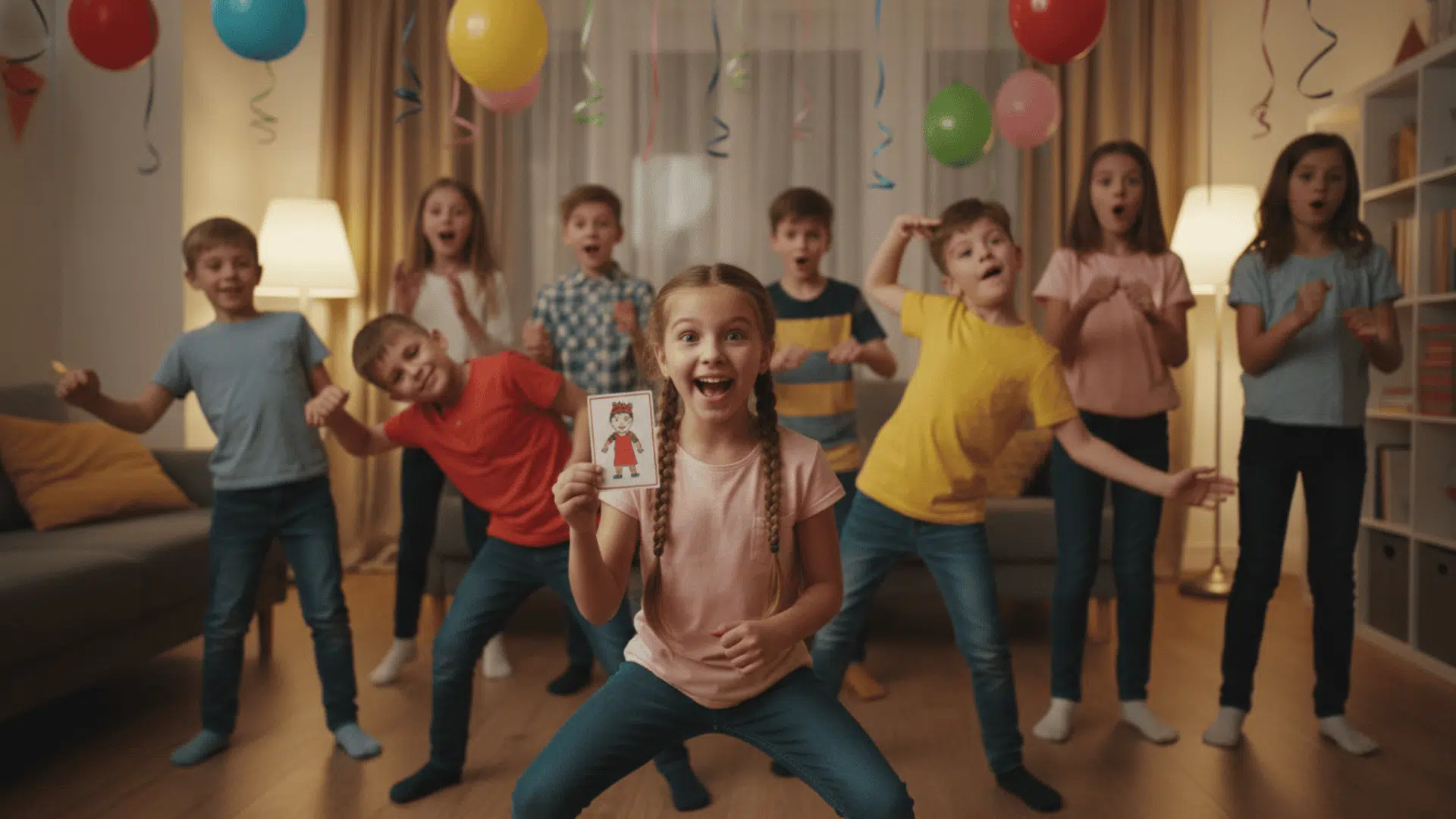
Dance when music plays, freeze when it stops. Challenge cards add creative poses beyond basic freezing.
Quick Stats: 5 min setup | HIGH energy | Very loud | $3 budget | 12×12 feet space
What You Need: Music player with kid-friendly playlist, 15-20 challenge cards in a bowl, clear dance floor
How to Play: Kids dance freely while music plays. When music stops, they freeze instantly. The traditional version eliminates movers. Challenge Card Twist: When music stops, pull a card from the bowl. Everyone freezes in that pose: “flamingo stand,” “superhero landing,” “tree in wind.” No elimination – just silly poses.
What Can Go Wrong + Fix: Kids argue who moved? Adults judge together, not solo. Music too fast? Pick songs with clear beat changes. Poses too hard? Include easy options like “sleeping cat” or “robot.”
Age Twist: Ages 4-6 hold poses for 5 seconds. Ages 7-9 hold for 10 seconds. Ages 10-12 add balance challenges.
Pro Tip: Let the birthday child pull challenge cards from the bowl. Gives them spotlight moments.
10. The Chocolate Game (No-Mess Version)
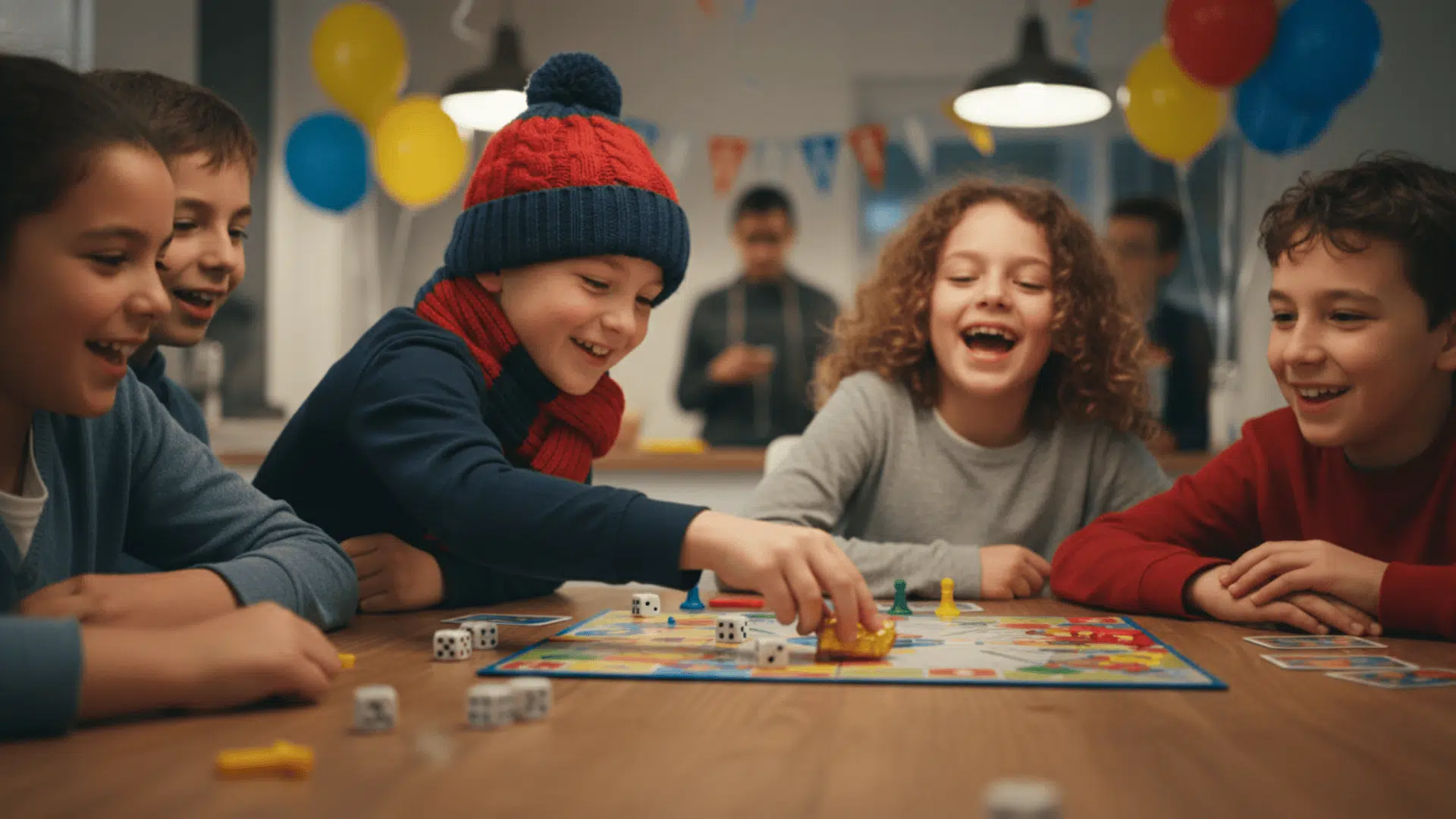
Race to unwrap and eat chocolate using a knife and a fork while wearing winter gear. No-mess version uses wrapped candy bars.
Quick Stats: 10 min setup | LOW energy | Loud laughter | $12 budget | Table space needed
What You Need: Large wrapped chocolate bar on a plate, knife and fork, hat, scarf, mittens, dice, wet wipes
How to Play: Kids sit in a circle around a table with a chocolate in the center. Take turns rolling the dice. First to roll a six rushes to put on a hat, scarf, and mittens, then cuts chocolate with a knife and fork to eat. Others keep rolling. The next person who rolls six takes over immediately. No-Mess Twist: Use individually wrapped mini bars instead of one large bar. Less melting, easier cleanup.
What Can Go Wrong + Fix: Chocolate melts everywhere? Keep the room cool and use firm chocolate like Hershey bars. Kids fight over gear? Set 30-second turn limits. Allergy issues? Swap chocolate for cookies or crackers.
Age Twist: Ages 4-6, skip mittens, just use a hat. Ages 7-9 wear full gear. Ages 10-12: add oversized sunglasses.
Pro Tip: This works perfectly as your “calm game” before cake. Sitting activity that still feels exciting.
11. Egg and Spoon Race (Indoor Safe Edition)
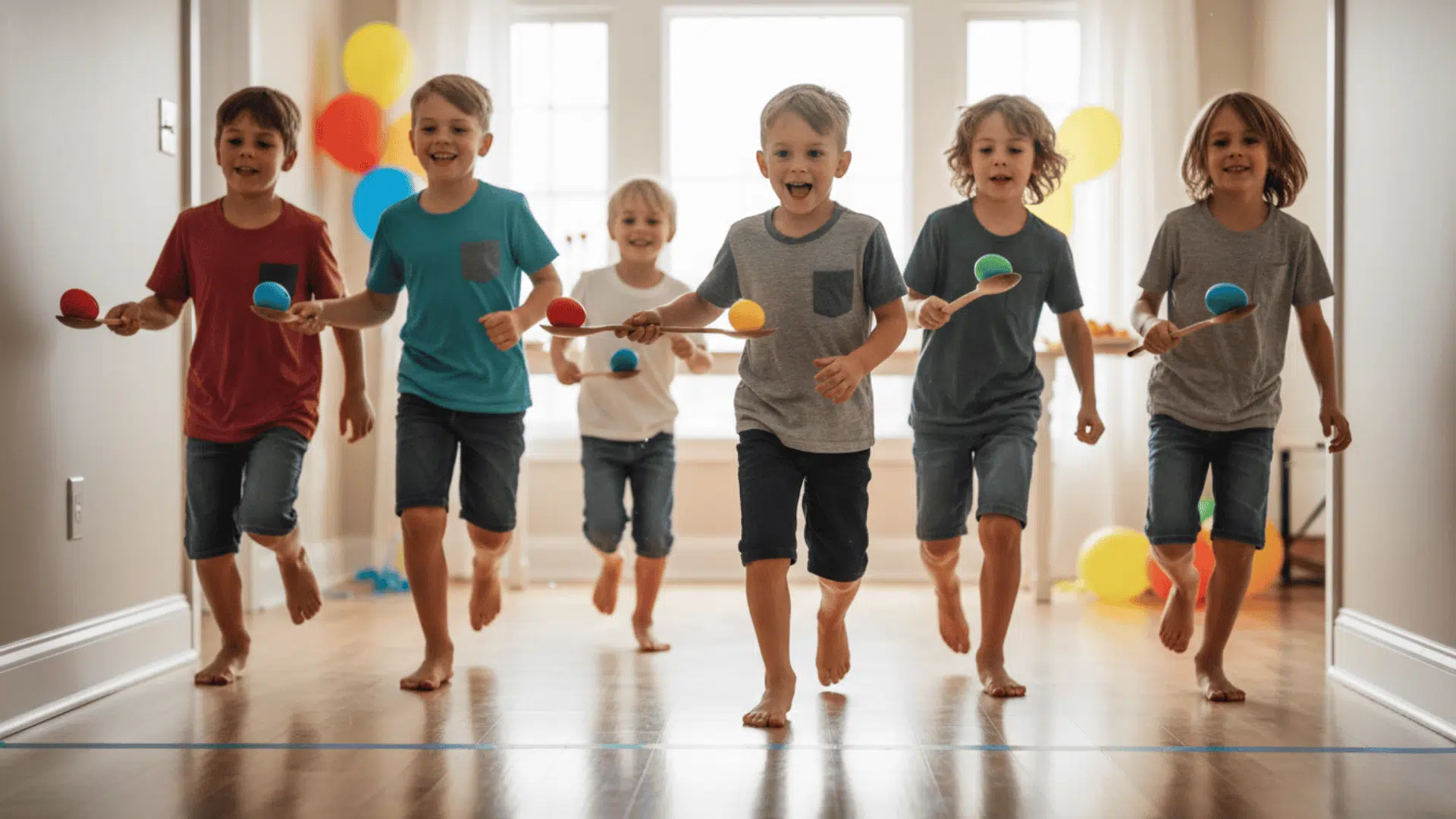
Balance an egg on a spoon while racing to the finish line. Indoor version uses plastic eggs, so nothing breaks.
Quick Stats: 5 min setup | MEDIUM energy | Moderate noise | $6 budget | 15 feet length
What You Need: One spoon per child, plastic Easter eggs (or ping pong balls), start and finish line markers, masking tape
How to Play: Mark start and finish lines 15 feet apart with tape. Each child holds a spoon in one hand with an egg balanced on top. On “go,” they race to the finish line. If egg drops, return to the start. First across wins. Indoor Safe Twist: Use plastic eggs that won’t crack or make a mess. Add fun obstacles like “hop three times” or “spin once.”
What Can Go Wrong + Fix: Eggs roll away constantly? Use slightly larger serving spoons. Too easy? Make kids hold a spoon in their non-dominant hand. Not enough space? Create a relay version with shorter distances.
Age Twist: Ages 4-6 walk only, no running. Ages 7-9 speed walk or jog. Ages 10-12 run with obstacles.
Pro Tip: Buy Easter eggs on clearance after the holidays. Store them for year-round party use.
12. Sleeping Lions (With Secret Missions)
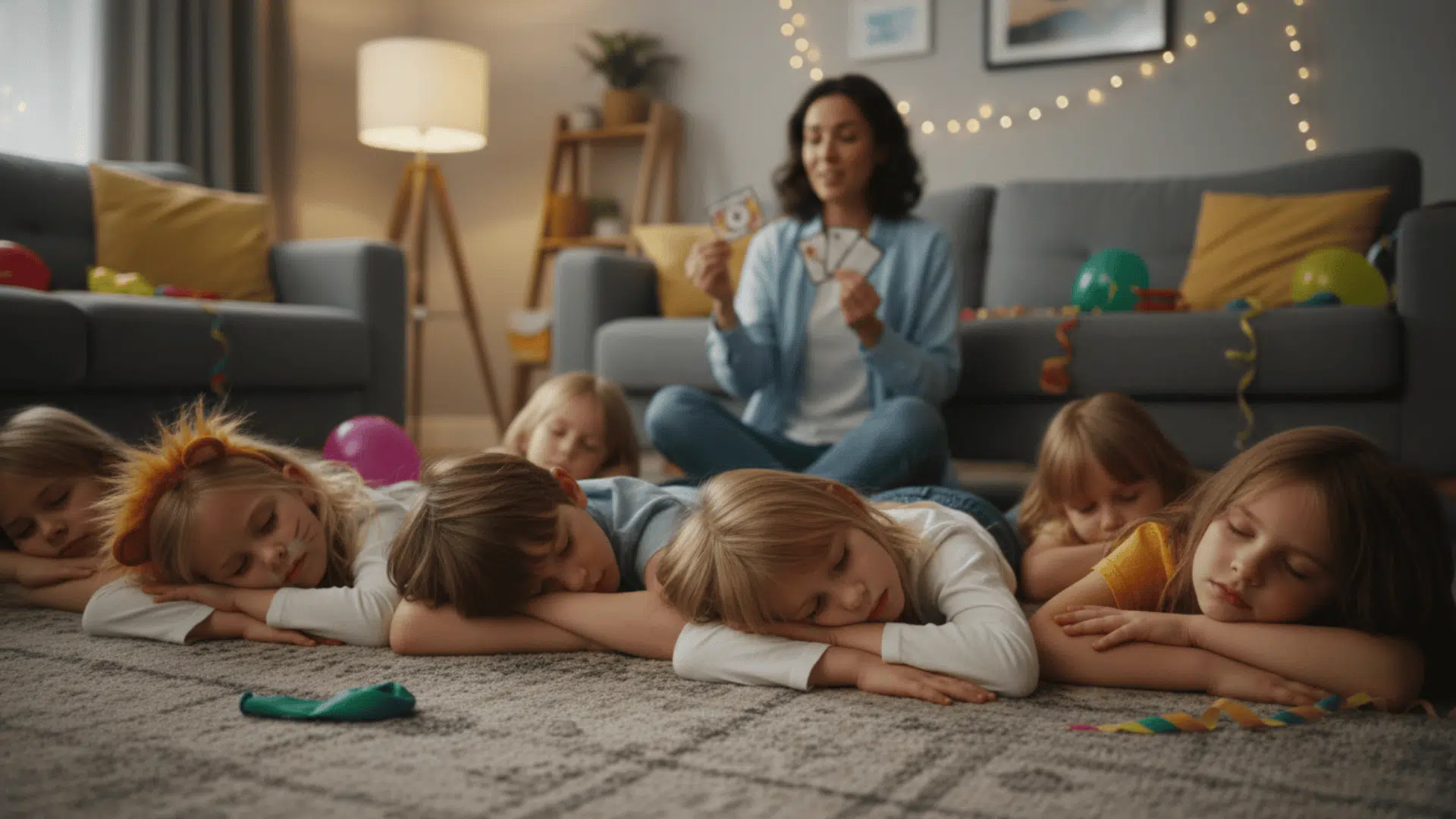
Kids lie still and silent on the floor. Secret mission cards give eliminated players a role rather than leave them bored.
Quick Stats: 2 min setup | VERY LOW energy | Whisper quiet | $2 budget | Floor space
What You Need: Soft mat or carpet area, timer set for 5 minutes, secret mission cards in an envelope
How to Play: All kids lie on the floor like sleeping lions – completely still and quiet. One adult watches for movement or sound. Anyone who moves or talks is “out.” Secret Mission Twist: Eliminated kids draw a mission card: “make silly face at lions,” “tiptoe around making wind sounds,” “tell joke from doorway.” They try to break others without touching them. The last lion standing wins.
What Can Go Wrong + Fix: Kids wiggle constantly? Allow one position change every minute. Room too exciting? Dim the lights slightly. Over too fast? Give verbal warnings before official elimination.
Age Twist: Ages 4-6 play for 2 minutes max. Ages 7-9 attempt full 5 minutes. Ages 10-12 add “no smiling” rule.
Pro Tip: Position this right before cake time. Calms rowdy kids and gives parents a moment to set up food.
13. Finale Game: Piñata Points or Confetti Countdown

End your party with a bang. Choose piñata action or mess-free confetti poppers for that final excitement boost.
Quick Stats: 15 min setup | MEDIUM energy | Very loud | $15-25 budget | Open space needed
Piñata Points Option:
What You Need: Piñata filled with candy/toys, plastic bat, trash bags
How to Play: Hang piñata at child’s shoulder height. Kids take turns hitting until it breaks. The modern version skips blindfolds. Points Twist: Assign point values to different colored candies. Kids count points instead of keeping everything.
Confetti Countdown Option:
What You Need: One confetti popper per child ($1 each), party favor bags
How to Play: Give each child a popper. Count down from 10 together. Everyone pulls on “1.” Hand out favor bags during the confetti chaos. Snap a group photo in the colorful mess.
What Can Go Wrong + Fix: Piñata won’t break? Pre-cut a small slit before the party. Confetti cleanup disaster? Use tissue paper strips instead – vacuum-friendly.
Age Twist: Ages 4-6 need pull-string piñatas (no hitting). Ages 7-12 handle both options fine.
Pro Tip: Schedule this 10 minutes before pickup time. Natural party ending that sends kids home smiling.
Wrapping Up
You’ve got the complete game toolkit. Use the stack formula to build your lineup – welcome, move, laugh, calm, and big finish.
The real secret? Short rounds keep focus. Teams reduce drama. One quiet game in the middle gives everyone a breather when sugar hits.
Stop overthinking this. Kids just want to play with friends and eat cake. Pick your games tonight, grab supplies tomorrow, then show up ready to laugh alongside them.
What’s next? Test one game this weekend. Come back and tell other parents which one saved your party and which flopped. Real experience beats perfect planning.
Screenshot the Quick Party Formula table. When chaos hits, and kids start arriving, you’ll need that reference.
Now go create a party worth remembering.