
Does your baby grunt? During feeding. While sleeping. Even when they seem perfectly content.
You’ve Googled it three times today. You’ve watched them closely. And you’re wondering: Is this normal? Should I be worried?
Here’s the good news: baby grunting is usually harmless. Most of the time, it just means your little one is learning how their body works. They’re figuring out digestion, breathing, and bowel movements.
That said, some grunting does signal a problem.
This guide explains seven common reasons babies grunt. You’ll learn when it’s normal and when to call your doctor. Plus, you’ll get simple tips to help your baby feel comfortable.
Let’s clear up the confusion.
Want solutions now?
What Is Baby Grunting?
A baby’s grunt is a short, deep, throaty sound. Not crying. Not cooing. It’s an effort sound – like when you lift something heavy and go “hngh.”
You probably notice it most during diaper changes, feeding time, or when your baby’s face turns red.
How to Spot the Difference?
| Sound Type | Key Characteristics |
|---|---|
| Grunting | Short bursts Deep, guttural tone No tears Happens during effort |
| Crying | Long wails High-pitched Tears and distress Loud and urgent |
| Cooing | Soft, musical sounds Happy tone Occurs when content and awake |
What’s Happening Inside?
Your baby tightens their belly muscles to push. This forces air through their voice box. Grunt.
The issue? They haven’t learned to relax their pelvic muscles yet.
Imagine pushing against a locked door. You’d strain too. That’s exactly what your baby is doing. They’re pushing with all their might while their body works against them.
It’s frustrating for them. Concerned for you. But completely normal. Their body just needs time to figure out the coordination. Usually, a few weeks to a few months.
Now let’s talk about why this happens so often.
Most Common Reasons Babies Grunt
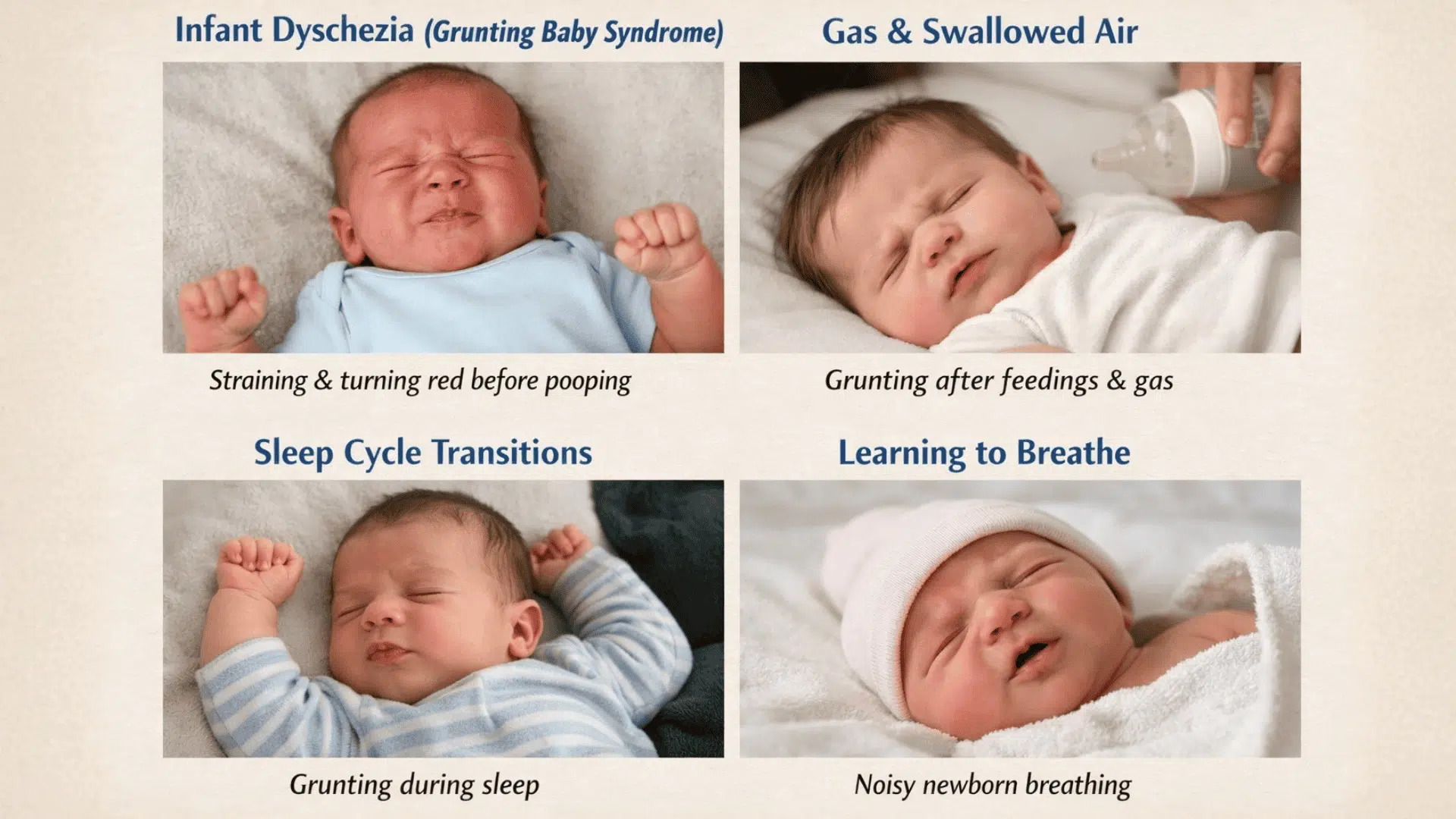
Here’s what’s usually behind all that noise.
1. Infant Dyschezia (Grunting Baby Syndrome)
This is the number one reason.
Infant dyschezia means your baby can’t coordinate pooping yet. They push with their belly while their pelvic floor stays tight. So they strain, grunt, and turn red for 10 to 30 minutes. Then soft poop comes out.
According to the Journal of Pediatric Gastroenterology and Nutrition, this affects healthy infants under 6 months and resolves on its own.
Key signs: Straining before pooping, red face, soft stools (not hard), happen multiple times daily.
Most babies figure this out by 2 to 3 months.
2. Gas and Swallowed Air
Babies swallow air during feedings, crying, and breathing. Moving it through their tiny digestive system takes effort. You’ll hear more grunting after meals or when they’re lying flat.
3. Sleep Cycle Transitions
Babies shift between sleep stages every 45 to 50 minutes. During these transitions, they grunt and move. They’re not awake.
Research shows newborns spend 40 to 50% of sleep in active REM (vs. 15% for adults). More REM means more grunts. This improves by 3 to 4 months.
4. Learning to Breathe
Newborns practice coordinating breathing. Fast, slow, pauses (periodic breathing). Medical experts confirm this is normal in the first three months.
Let’s look at what to expect at different ages.
Age-Specific Grunting Expectations
Grunting changes as your baby grows. Here’s what’s normal at each stage.
Quick Reference: Grunting by Age
| Age | Grunting Frequency | What’s Happening |
|---|---|---|
| 0-1 month | 5-10 times/day | Peak grunting phase |
| 1-3 months | 2-4 times/day | Learning coordination |
| 3+ months | Rare/occasional | Mostly quiet |
0 to 1 Month: The Noisiest Phase
This is peak grunting time. Your newborn sounds like a tiny barnyard animal.
What you’ll see and hear:
- Grunting every few hours, especially at night
- Face turns bright red during diaper changes
- Noisy, restless sleep with frequent squeaks
- Random grunts even when completely calm
The baseline: Expect 5 to 10 grunting episodes per day. According to pediatric studies, this is when muscle coordination is at its weakest.
1 to 3 Months: The Turning Point
You’ll notice the volume dropping. Progress happens fast.
What you’ll see and hear:
- Quieter nighttime sleep (finally!)
- Quicker bowel movements with less drama
- More alert, content periods between feeds
- Grunting cuts to 2 to 4 times daily
The shift: By 8 weeks, most babies poop without the full-face gymnastics. Their body clicks into gear.
3+ Months: The Quiet Zone
The grunt phase ends for most babies.
What you’ll see and hear:
- Mostly silent sleep
- Smooth, easy bowel movements
- Rare grunts only during harder stools
- Long peaceful stretches
The red flag: Still grunting constantly at 4 months? Time to call your pediatrician. Persistent grunting past 6 months needs medical evaluation.
Now, let’s talk about when grunting is nothing to worry about.
When Grunting Is Probably Normal?
Most grunting falls into the “don’t worry” category. Here’s how to tell.
Your baby’s grunting is almost always fine if it happens during or right after feeding, during bowel movements, or while they’re sleeping.
The key sign? Your baby is happy and content between episodes. They’re eating well, producing wet diapers, and gaining weight on schedule. The grunts come and go, and when they stop, your baby goes back to being calm and alert.
Also check the poop. If stools are soft, yellow, or seedy (for breastfed babies) or tan and pasty (for formula-fed babies), you’re in the clear. Hard, dry, pebble-like poops are a different story and signal constipation, not normal grunting.
| Bottom line: Happy baby + soft poops + regular eating = normal grunting. No action needed except patience. |
Let’s look at the warning signs that do need attention.
Warning Signs That Require Attention
Most grunting is harmless. But some signs mean you need to call your doctor right away.
- Grunting with every single breath – This signals respiratory distress, not normal digestion
- Blue or gray skin, lips, or tongue – Your baby isn’t getting enough oxygen
- Flaring nostrils or chest pulling inward – These are signs of labored breathing
- High fever (100.4°F or higher in babies under 3 months) – Combined with grunting, this needs urgent care
- Refusing to eat or extreme lethargy – Your baby is too tired to feed or barely responds to you
- No bowel movement for 7+ days – Especially if accompanied by a hard, swollen belly
- Blood in stool or vomit – This is never normal
- Excessive crying that won’t stop – If your baby screams for hours and nothing helps
These symptoms require same-day medical attention. Don’t wait. Trust your instincts. If something feels wrong, call your doctor.
Now let’s talk about simple ways to help your baby feel better.
How to Help Your Baby (Step-by-Step)

You can’t “cure” normal grunting, but you can make your baby more comfortable.
1. Burp Thoroughly After Every Feed
Trapped air makes grunting worse. Get those burps out.
How to do it:
- Hold the baby upright against your chest for 5 to 10 minutes
- Pat or rub their back gently in circular motions
- Try different positions: over the shoulder, sitting on your lap, lying face-down on your forearm
- Burp halfway through feeds, not just at the end
2. Try Tummy Massage (When Baby Is Calm)
A gentle massage helps move gas through their system.
How to do it:
- Lay the baby on its back
- Use your fingertips to make small circles on their belly (clockwise direction)
- Start at the belly button and spiral outward
- Do this 2 to 3 times daily, not right after eating
3. Use the Right Feeding Position
How you hold your baby during feeds affects how much air they swallow.
Best positions:
- Keep baby’s head higher than their stomach (30 to 45-degree angle)
- For bottle feeding, tilt the bottle so milk fills the nipple completely
- For breastfeeding, ensure a good latch to minimize air intake
- Feed when the baby is calm, not crying desperately
4. Do Gas Relief Exercises
Simple leg movements help release trapped gas.
Bicycle legs: Gently move baby’s legs in a pedaling motion for 30 seconds. Repeat 3 to 4 times daily.
Knees to chest: Gently press baby’s knees toward their belly, hold for 5 seconds, release. Repeat 5 times.
Tummy time: When the baby is awake and supervised, place them on their stomach for short periods. This puts gentle pressure on the belly and helps move gas.
5. Keep Baby Upright After Meals
Gravity is your friend. Hold the baby upright for 15 to 20 minutes after feeding. This helps prevent reflux and makes digestion easier.
When to Stop Helping? Don’t use rectal thermometers, cotton swabs, or suppositories to stimulate bowel movements. These can make your baby dependent and delay their natural learning process.
Expert Tips from Pediatric Professionals
Here’s what doctors and midwives want you to know about baby grunting.
Medical experts agree on several key points. Wait 30 to 60 seconds before picking up a grunting baby during sleep.
Many settle on their own without waking. Pediatricians emphasize one rule: trust the poop, not the performance. If the stool is soft, your baby is fine, regardless of how dramatic it looks.
According to Cleveland Clinic research, babies cry during infant dyschezia to create abdominal pressure, not because they’re in pain.
Doctors evaluate breathing patterns, not just sounds. Fast breathing over 60 breaths per minute, pauses longer than 10 seconds, or chest pulling are red flags. Random grunts without these signs are normal. Most grunting resolves by 12 to 16 weeks as systems mature.
Let’s wrap this up with what matters most.
Conclusion
Your baby grunts because they’re learning. Learning to poop, breathe, and digest. It’s not pain. It’s progress. Most grunting disappears by 2 to 3 months. Some babies take until 6 months. Either way, it ends.
Normal grunting means soft stools, a happy baby between episodes, and good weight gain. If you see these, relax.
You’re both doing fine. But trust your gut. Grunting with every breath, blue skin, refusal to eat, or fever? Call your doctor immediately.
Try the simple fixes: burp well, massage gently, keep baby upright after feeds. Be patient while their body learns. That 2 AM panic you felt? Every parent has been there. Now you know what to listen for. You’ve got this.
Questions about your baby’s grunting? Talk to your pediatrician at your next visit.
Frequently Asked Questions
Can I Give My Baby Gripe Water or Gas Drops for Grunting?
You can try gas drops (simethicone) after checking with your pediatrician. Gripe water isn’t recommended for babies under six months and doesn’t treat infant dyschezia.
Is Grunting Different for Breastfed vs. Formula-Fed Babies?
The grunting is the same, but breastfed babies typically have softer, more frequent stools. Formula-fed babies may have firmer stools and grunt slightly less often.
Should I Wake My Baby if They’re Grunting in Sleep?
No. Most sleep grunting is a normal transition between sleep cycles. Wait at least 60 seconds. Most babies settle without waking. Only intervene if distressed.